

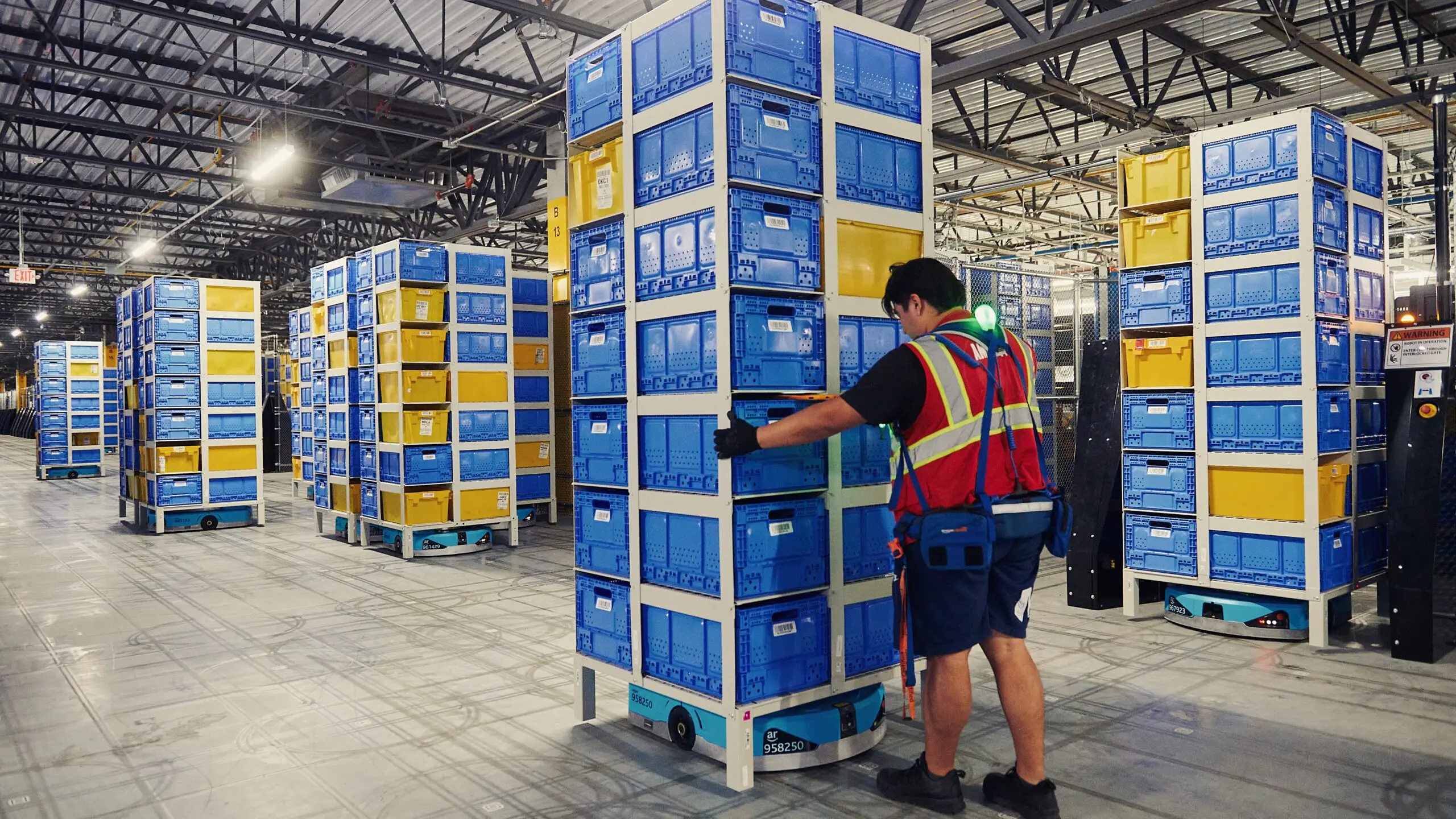
No organization on the planet operates a larger robotic workforce than Amazon. The company already has more than 1 million robots working inside its warehouses around the clock, the machinery that makes tens of millions of same-day and next-day package deliveries possible every day. And Amazon is preparing to expand that fleet substantially in the years ahead, building new factories dedicated to churning out increasingly capable machine workers.
Yet even with that army of automation, Amazon remains the second-largest corporate employer in the world, with more than 1.5 million full-time and part-time human workers, according to its 2025 annual report. Company executives argue the growing robot fleet has lightened the load on people by absorbing the toughest fulfillment-center tasks—the ones most likely to cause physical fatigue and injury. Labor advocacy groups and independent researchers, however, say the evidence paints a more complicated picture.
"For the last 100 years, most of the automation that we've seen usually happens away from workers—you're taking that high-risk task away from the worker, and you're doing so in a way that is not physically proximate," said Brad Greenwood, a professor of business at George Mason University. "The rise of collaborative robots really changes that dynamic for two reasons: one is that it is physically proximate, and two, the robot has the ability to dictate the pace of work."
In many respects, robotics and artificial intelligence are well suited to the relentless tempo of e-commerce fulfillment. Amazon's promise of rapid delivery to roughly 200 million Prime subscribers requires hundreds of thousands of people to assemble and ship orders that often bundle a bewildering variety of products.
Much of that work also involves what researchers politely call the "dull, dirty, and dangerous" tasks that people would generally prefer to hand off to machines. According to the US Occupational Safety and Health Administration, the injury and illness rate in the American warehouse sector has typically run more than double the average across all industries.
"You have almost 2 million people working in the warehousing sector in the United States, and it's characterized by very high turnover and very high workplace injury rates," Greenwood said.
But robots remain far from capable of handling everything a human worker can do. That means Amazon still relies on a massive human workforce operating in tandem with its growing fleet of wheeled robots and robotic arms—and workplaces can become complicated when people are expected to keep pace with their mechanical counterparts.
How Amazon built the world's largest robot fleet
Amazon's robotic era began with a pivotal acquisition. In 2012, the company bought Kiva Systems, one of the earliest firms to pioneer wheeled mobile robots that carry racks of inventory to warehouse workers rather than forcing people to walk miles of aisles collecting items off shelves.
Kiva was renamed Amazon Robotics after the deal, and the unit has since focused on deploying arrays of mobile robots and robotic arms that Amazon largely manufactures in-house at facilities in Massachusetts. In 2025 the company announced it would add production plants in Austin, Texas, and Greenwood, Indiana, to produce even more machines.
"There's a theme of how we look at the challenges that we can help our associates and our employees with, and how we can make our customers' lives better through these technologies," said Scott Dresser, vice president of Amazon Robotics. "Each step of the way, we are tackling a hard or deep set of technical challenges to achieve that goal."
Most of the million-robot fleet still consists of those wheeled mobile units. Amazon says its robotic Sequoia system can identify and store items up to 75 percent faster by coordinating swarms of them. The Hercules and Titan robots—roughly the size of a pool table and a baby grand piano, respectively—roam warehouse aisles to retrieve tall fabric shelving units called pods, packed with plastic tote crates, and haul them to human employees at workstations.
Such mobile robots typically follow grid lines of stickers laid out on the floor and stay within fenced areas away from people. The newest mobile robot, Proteus, carries sensors that let it operate safely around humans and obstacles in a freer-roaming role. Swarms of robots traveling through narrow lanes between storage pods can create robotic traffic jams, which is why Amazon began coordinating them with a suite of AI foundation models collectively called DeepFleet, designed to predict congestion before it happens.
The robotic arms race
More recently, Amazon has been deploying a growing number of robotic arms that can grab items stowed high inside inventory pods, sort packages, place them into carts or onto mobile robots, and handle the vast variety of individual products customers order online. The company expects to more than double its existing fleet of robotic arms this year, according to chief financial officer Brian Olsavsky. Dresser described the current deployed count as being in the single-digit thousands.
Amazon initially bought third-party robotic arms to lift and stack heavy pallets and bins. The first arm developed in-house to sort individual mailers and boxes from cluttered piles—called Robin—began testing in 2021 and debuted at a facility in Lakeland, Florida, in 2022.
"With Robin, it was really that first attempt at taking a number of customer orders all in a jumble and building the advanced robotics to identify the items in that scene, to strategize on how to pick them up and build a motion plan that would be successful in placing it down on one of our mobile drive units," Dresser explained.
The arm uses eight suction cups to pick up individual packages. Before acting, its software analyzes a top-down view of the conveyor belt and quickly ranks possible picking actions. Early versions relied on hand-crafted strategies, each with limitations: one that prioritized larger packages struggled when smaller ones lay on top, while another favoring packages near the top of a pile failed to retrieve partially buried items.
The fix was machine learning. A model trained on more than 394,000 picking actions from deployed arms estimated the probability of a successful pick, then an online ranker prioritized the best actions. In one trial, the best machine-learning method achieved a 93.73 percent success rate versus 92.28 percent for the best traditional algorithm—a gap that translated into roughly 16,500 fewer failed picks across more than a million attempts. A later experiment involving 2 million picks showed the approach could cut the failed-pick rate by 20 percent.
Next came Cardinal, an arm that can place packages weighing up to 50 pounds into wheeled carts eventually routed to trucks at loading docks. It began operating in Nashville, Tennessee, in November 2022.
"Think of it as a game of Tetris: You're sorting packages, and you're placing them into the cart, and you want to be able to pack that as densely as you possibly can," Dresser said. Dense containers help on both sustainability and transportation-cost fronts. Cardinal built on lessons from Robin while adding dense packing, and Amazon has only begun deploying it in larger numbers.
Robin and Cardinal can handle several dozen package variations. The newer Sparrow arm was built for a far harder problem: the hundreds of millions of products of varying shapes and sizes that flow into customer orders, consolidating items from partially filled totes into densely packed ones.
"When we think about how AI applies to the physical space in robotics, Sparrow was really the first place where we truly deployed foundation models that enabled us to deal with that high diversity of products," Dresser said. Such models eliminated the need to manually code every item and helped the team build generalized perception and action models that work across different robot designs and grasping methods.
Most arms have relied primarily on vision. Vulcan, the newest, is the first to combine vision with force-feedback sensors that provide a sense of touch, letting it insert, stow, or extract items inside fabric-covered pods—manipulations that suction-based systems struggle with. Vulcan began operating at sites in Spokane, Washington, and Hamburg, Germany, in 2025 and is expected to scale up in 2027.
Parsing the human impact
According to Amazon, each new robot benefits its human workforce. Vulcan, for instance, handles picking and stowing in the top rows of inventory pods that would otherwise require a step-ladder, as well as items just above the floor, freeing employees to work at more comfortable heights.
But investigations by labor groups, journalists, and Congress have painted a less rosy picture. The Strategic Organizing Center, a coalition of trade unions based in Washington, DC, published reports in 2021 and 2022 showing higher injury rates at Amazon's robotic warehouses than at non-robotic ones, drawing on injury data companies reported to the federal government from 2017 through 2020. A survey of nearly 1,000 Amazon workers that February found consistent reports that robots increased the expected pace of work, forcing fast, repetitive motions.
A 2024 Senate Committee on Health, Education, Labor and Pensions investigation found that Amazon's own internal data suggested a link between robotic productivity and added pressure on human workers. Amazon has called such reports flawed and reliant on data predating its newest robots, noting that since 2019 its global recordable incident rate has improved 43 percent and its lost-time incident rate 70 percent, improvements it says have run in parallel with robotics growth.
The most nuanced findings came from a study published in the ILR Review in April 2025. It found that Amazon's robotic warehouses saw a 40 percent decrease in severe injuries compared with legacy fulfillment centers—evidence that offloading the most physically punishing tasks helps. But the same study found a 77 percent increase in less severe injuries tied to physical strain from repetitive motion.
"At least one of the mechanisms by which this appears to be manifesting is through the pace of work, in that pick rates for the robotic fulfillment centers are off the charts higher," said Greenwood, a coauthor. A faster tempo driven by partial automation can mean "the robot is dictating the pace of work" and pushing employees into quicker repetitive actions. The study drew partly on company data covering more than 150 warehouses from 2016 through 2019, and Greenwood argues the dynamics remain relevant given persistent turnover across the warehousing sector. He and his colleagues also analyzed online comments from fulfillment-center employees, who described robotic work as less physically stressful but mentally exhausting because of repetitiveness and elevated productivity expectations.
Jobs, upskilling, and the hiring question
Amazon has promoted the robotics push as a source of new opportunities. Fulfillment centers with advanced robotics typically need 30 percent more employees in reliability, maintenance, and engineering roles, and each new robot factory is expected to bring more than 300 jobs.
"As we recognize that each of these robotics developments can change the nature of work, we're providing opportunities for our employees to upskill and learn some of these things," Dresser said. "We've actually increased the number of robotic maintenance technicians that we have in the network by over 30 percent, and that is a much higher-skilled, higher-compensated job."
The company also frames automation as inseparable from a growing business. "As we've deployed robots over the past decade, we've seen our operational footprint grow, creating hundreds of thousands of jobs as we expanded our network," a spokesperson said.
Still, reporting in October 2025 surfaced internal strategy documents suggesting the robotics push could let Amazon reduce projected US hiring needs by more than 160,000 people by 2027 and 600,000 by 2033. A spokesperson said at the time that the documents reflected the views of just one group inside the company.
Whatever the hiring trajectory, debates over workplace safety are unlikely to fade. Only a small fraction of Amazon's US employees have unionized, but unions have "traditionally served a very good role in terms of improving worker safety," Greenwood said. "Developing a better relationship between management and labor is usually the best path forward to try to figure out how to reduce these injury rates, which would have benefits for Amazon as well." The first Amazon Labor Union, organized at a Staten Island warehouse in April 2022, has been pressing a Safety Bill of Rights outlining changes it wants—under a banner declaring, "We are not robots."
Source: Ars Technica News