

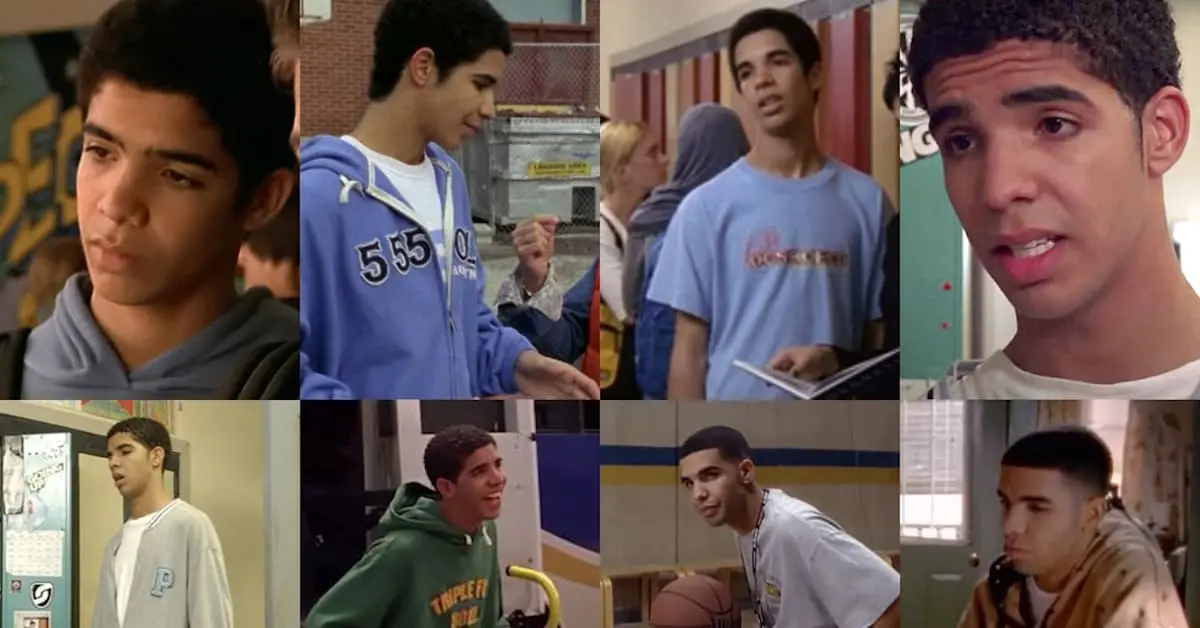
The Audition That Found Jimmy Brooks
In 2001, Aubrey Graham was a lanky 14-year-old from Toronto with no professional acting credits. He walked into an audition for Degrassi: The Next Generation hoping to land his first screen role. Producers had already seen hundreds of young actors while casting the revival of a beloved Canadian teen franchise, but one part remained stubbornly difficult to fill: Jimmy Brooks, a popular basketball player from a wealthy family. They needed someone who could project confidence and cool, yet also reveal warmth and vulnerability.
Graham read a scene. When he finished, the room stayed silent. The inexperienced teenager panicked. He apologized, asked if he had done something wrong, and offered to try again. The producers told him no, that it was fine. Then he stood to leave, accidentally snagged a light stand, shook everyone's hand, thanked them repeatedly and backed out of the room. Once the door closed, the four people behind the table looked at one another. They had found Jimmy Brooks.
Years later, Graham offered a very different memory of the same afternoon. He admitted he had gotten high before the audition after giving in to peer pressure while hanging out with other kids. The memory became almost existential for him. He sometimes wondered if the life that followed was real or if he was still in some coma, playing out an ideal life. The two versions of the story sit side by side: producers saw charisma and vulnerability; Graham remembered insecurity and a desperate desire to fit in.
Before Jimmy, Degrassi Was Already a Canadian Institution
By the time Graham auditioned, Degrassi had been part of Canadian television for more than two decades. The franchise began with short films in the late 1970s, then evolved into The Kids of Degrassi Street. It became a cultural phenomenon with Degrassi Junior High in 1987. Unlike glossy American teen dramas, the show used amateur actors who looked and dressed like real students. It dealt with puberty, peer pressure, pregnancy, abortion and suicide with a realism that rarely became preachy. The series drew millions of Canadian viewers, aired in more than 40 countries and won multiple awards. It continued with Degrassi High, a post-graduation film and a docuseries before going quiet in the early 1990s.
Almost a decade later, creators Linda Schuyler and Yan Moore considered a reunion special. They realized Emma, the daughter of Christine 'Spike' Nelson, whose teenage pregnancy had been a landmark storyline, would now be old enough for junior high. Instead of revisiting the past, they built a new generation of students while allowing old characters to return as adults. The result was Degrassi: The Next Generation, greenlit in 2000. More than 600 school-aged children would audition. One of them was Aubrey Graham.
Casting Aubrey Graham
Graham was raised primarily by his mother, Sandi, after his parents separated when he was five. He spent parts of his childhood in Toronto's west end and later Forest Hill, attending Forest Hill Collegiate Institute before transferring to Vaughan Road Academy. His father, Dennis Graham, was a drummer who had played with Jerry Lee Lewis, so music was present early. But television gave him his first real opportunity.
Actor Stephen Brogren, already known to Degrassi viewers as Archie 'Snake' Simpson, helped connect Graham with the casting team. Schuyler repeatedly recalled that something about him was immediately compelling. She described a charisma and warmth, a beautiful smile, and a vulnerability that the camera adored. Whatever the producers saw, it was enough to cast an unknown teenager in a central role.
Becoming Jimmy Brooks
Degrassi: The Next Generation premiered in October 2001. Graham first appeared as Jimmy in the Season 1 episode 'Family Politics.' At first, Jimmy fit a familiar high-school archetype: handsome, athletic, popular and wealthy. He played basketball, dated Ashley Kerwin and spent time with his best friend, Spinner Mason. But this was Degrassi, where archetypes rarely stayed simple. Over three seasons, Jimmy became more complicated. His privileged home life was marked by absent parents. His relationship with Ashley grew messy. His friendship with the impulsive Spinner was repeatedly tested. Underneath the confident jock was a sensitive, creative teenager interested in art and music, and insecure about other people's expectations. That emotional complexity made him central to the ensemble. Unlike Spinner, Jimmy was often the grounded presence. He could be stubborn and jealous, but there was a decency that made viewers trust him.
As the show became an international success, Jimmy became one of its most recognizable characters. Then, in the fourth season, the series changed his life forever.
The Gunshot That Changed Everything
No episode remains more unforgettable than 'Time Stands Still,' the two-part story that aired in October 2004 and tackled school violence with rare seriousness. Schuyler began thinking about a school-shooting storyline after the 1999 Columbine massacre, but it took years before the writers felt ready. At the cast read-through, the room went still. Schuyler said she felt physically sick as everyone learned where the story was going.
The episodes centered on Rick Murray, a troubled student who had previously abused his girlfriend. After returning to Degrassi, he became the target of relentless bullying. A cruel prank in front of the school led Spinner and Jay Hogart to manipulate Rick into believing Jimmy was responsible, even though Jimmy had been one of the few students kind to him. Rick returned with a gun, confronted Jimmy in a hallway and shot him in the back. Rick was killed during a struggle with another student.
Graham had no idea it was coming. He later recalled that someone told him to mentally prepare for the script but did not say there would be a shooting or that he would be the victim. The read-through became intensely emotional. Cast members held hands and cried. Jimmy survived, but the writers made a consequential choice: he did not recover fully. The shooting left him paralyzed. Rather than treating disability as a single special episode, the show explored the consequences over subsequent seasons. Viewers watched Jimmy navigate rehabilitation, anger, depression, relationships and acceptance. His disability became part of his character without defining all of it. He still dated, joked, painted, fell in love, fought with friends and imagined a future.
For Graham, the storyline raised difficult questions. He wondered what it meant for his future on the show. He did not want to spend the rest of his years in a wheelchair while his castmates moved on. But he also said the role gave him something to study, homework as an actor. He credited the show's refusal to soften life: it was good because life is messed up and it was not afraid to show that.
The Wheelchair Controversy
In 2021, as the show marked its 20th anniversary, writer James Hurst made a remarkable claim. He said the production once received a letter from a Toronto law firm stating that Graham would not return for Season 6 unless Jimmy's injury was healed and the character could walk again. Hurst said he asked Graham about it, and Graham denied knowing about the letter. Hurst then asked how he felt about continuing to play Jimmy in a wheelchair. According to Hurst, Graham said his friends in the rap game called him soft because he was in a wheelchair. Hurst's response became legendary among fans: tell them you got shot. How much harder can you get?
Graham stayed on the show, and Jimmy remained in his wheelchair. But the exchange revealed a collision between two identities. Jimmy Brooks had given Graham a career. Now Graham worried that Jimmy Brooks might make it harder for people to believe in Drake.
Double Life: Acting by Day, Rapping by Night
By the mid-2000s, Graham was living two professional lives. He spent his days filming Degrassi in Toronto as Jimmy Brooks. At night, he wrote, recorded and tried to build a separate career as Drake. Music evolved from a side project into a serious pursuit that consumed nearly every hour he was not on set. Executive producer Stephen Stohn said Graham sometimes slept in his dressing room because he had spent the night making music. He used acting money to finance recordings and manufacture CDs. Instead of waiting to be discovered, he distributed music himself and tried to create local momentum.
Graham also tried to keep the identities separate. Producers recognized his musical ambitions and wanted to incorporate them into Jimmy's storyline. Graham resisted. He played them mixtapes, but he did not want the show that made him famous to become a vehicle for introducing Drake. Stohn said the music side was one career and acting was another. They convinced him to do some rap, but it took effort.
In 2006, Drake released his first mixtape, Room for Improvement, reportedly pressing and distributing thousands of physical copies with his own money. Labels were not rushing to sign him. To much of the public, Aubrey Graham was still the kid from Degrassi. The following year, Comeback Season arrived. The video for 'Replacement Girl,' featuring Trey Songz, became the first from an unsigned Canadian rapper to appear on a major U.S. music video network. It gave Drake exposure that suggested his ambitions were not impossible.
The End of Jimmy Brooks
By 2008, Graham's music career was becoming difficult to contain. Jimmy graduated at the end of Season 7, later than many classmates because his rehabilitation had forced him to repeat a year. Graham's time as a regular cast member was ending. He returned once more as a guest star in Season 8. His final appearance as Jimmy Brooks came in the episode 'Lost in Love: Part 2,' which aired in Canada in January 2009. There was no grand farewell. Jimmy simply moved forward with his life, while the actor who had played him for most of his adolescence prepared to do the same.
Less than a month later, Drake released So Far Gone. The mixtape dramatically altered his career. 'Best I Ever Had' became a massive hit. 'Successful,' featuring Trey Songz and Lil Wayne, pushed him further into hip-hop's center as Lil Wayne and Young Money entered the picture. For eight years, Aubrey Graham had been recognizable as Jimmy Brooks. Within a very short period, Drake began to eclipse the character who made him famous. The transformation looks seamless in retrospect, but Graham was leaving a steady television job for a music industry that offered no guarantees.
Could Hip-Hop Take Drake Seriously?
Drake's acting career followed him into hip-hop. His years playing Jimmy Brooks, especially in a wheelchair, became an easy way for critics to question whether a former Canadian teen actor could possess the authenticity rap often demanded. 'Wheelchair Jimmy' became a reference point for anyone doubting Drake's credibility. That made Graham's earlier worry about what his rapper friends thought seem prophetic. Over time, however, his relationship with Degrassi evolved. Rather than erasing Jimmy Brooks, Drake grew comfortable letting the character become part of his mythology. He referenced the show in interviews, laughed at jokes and reminded people that the global rap superstar had once filmed a Canadian teen drama.
In July 2017, he posted an $8.25 residual cheque from the series on social media, joking that Degrassi money was still coming in. By then, Drake had little left to prove about whether a former Degrassi actor could succeed in hip-hop. The part of his history that once complicated his credibility could finally be treated with affection.
Jimmy Brooks Never Left
In June 2018, Drake released the music video for 'I'm Upset,' turning a song with a mixed reception into a memorable celebration of his Degrassi past. Directed by Karena Evans, the video was essentially a Degrassi: The Next Generation reunion disguised as a Drake video. It brought together Shane Kippel, Nina Dobrev, Stacey Farber, Jake Epstein, A.J. Saudin, Adamo Ruggiero, Lauren Collins, Cassie Steele, Ephraim Ellis and Stefan Brogren, along with Jason Mewes and Kevin Smith. Drake and his former castmates returned to the halls of Degrassi Community School for a reunion party filled with inside jokes. The closing credits paired original footage with new clips as the familiar theme song played.
For millennials who grew up watching the show, the video felt like more than nostalgia. Drake had become one of the biggest stars on the planet and could have built a music video around any chapter of his life. He chose to return to the fictional high school where millions first met him. The same chapter that once complicated his rap credibility had become something he could celebrate on his own terms. Years earlier, Graham had resisted letting Degrassi become a vehicle for his music. Now Drake was bringing Degrassi into his music himself. Jimmy Brooks was not an embarrassing footnote. He was part of the origin story.
Jimmy Brooks Prepared Drake for Drake
No one's post-Degrassi life has looked like Aubrey Graham's. As Drake, he became one of the most commercially successful recording artists of his generation, building a global brand while becoming intertwined with Toronto's modern cultural identity. Yet after all the records, awards, tours, feuds and memes, Jimmy Brooks never completely disappeared. That does not diminish Drake's success. It makes his route more unusual.
It would be too simple to say Degrassi created Drake, or that the vulnerability in his music can be traced directly to Jimmy Brooks. What can be said is that before Drake built a career around translating heartbreak, insecurity, ambition and complicated relationships into entertainment, Aubrey Graham spent eight formative years performing complicated emotions in front of a camera. Before millions of fans dissected his relationships through lyrics, viewers watched Jimmy navigate breakups, friendship, jealousy, trauma and uncertainty.
Degrassi gave Graham his first audience, years of camera experience and an early education in being recognized by strangers. It also gave him an identity powerful enough that he spent part of his early music career worrying whether he could escape it, only to realize he did not need to. In many ways, Jimmy Brooks prepared Drake for Drake. Origin stories tend to look obvious once you know how they end. It is tempting to look back at the teenager in that Toronto audition room and imagine everyone saw what was coming. Nobody did. There was no OVO, no chart records, no Grammys, no stadium tours. There was an awkward 14-year-old at his first audition, worried that silence meant he had done something wrong. When he left the room, nearly knocking over a light stand, four people behind the table agreed they had found Jimmy Brooks. It would be years before the rest of the world discovered Drake.
Source: Complex News