

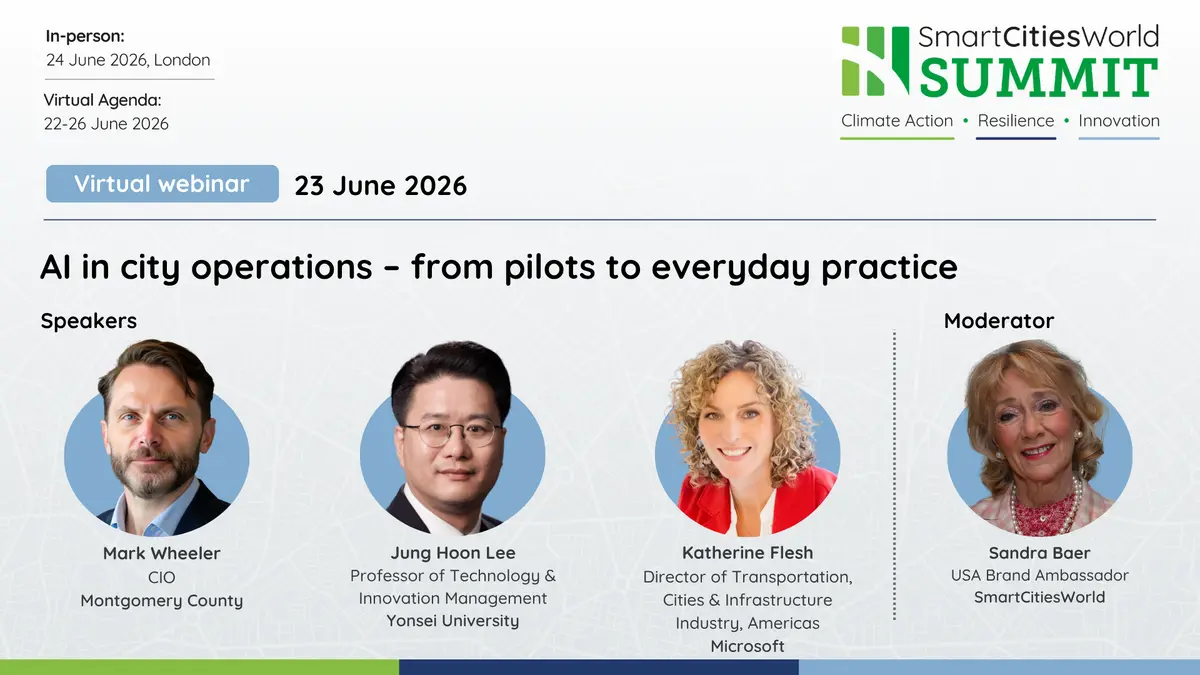
City leaders are moving artificial intelligence out of isolated experiments and into the daily rhythms of urban management. A new on-demand panel discussion has focused on how AI, edge computing and computer vision can help municipalities turn growing volumes of urban data into smarter, faster decisions and more responsive services. The conversation comes as local authorities face mounting pressure to improve everything from traffic flow and waste collection to public safety, energy use and building maintenance, often with limited budgets and aging infrastructure.
The central message is that the next phase of urban AI will not be defined by novelty. It will be defined by integration. Cities that once tested a single camera or a pilot dashboard are now asking how those tools can support workforce decision-making across departments. That requires unified data, agentic AI and secure digital foundations rather than a patchwork of disconnected systems.
Why cities are turning to AI now
Urban data is expanding faster than most city teams can analyze it. Sensors, cameras, transit systems, utility meters, building management platforms and citizen service requests all generate streams of information. Used well, that data can reveal patterns that human teams might miss. Used poorly, it can overwhelm staff and create new risks.
The panel discussion highlights three technologies that are shaping this shift:
- Edge computing: Processing data close to where it is collected can reduce latency, lower bandwidth costs and support faster responses. A camera that detects a blocked exit or a sensor that identifies rising heat in a tunnel can act in seconds rather than sending every byte to a distant cloud.
- Computer vision: Machine learning models can interpret images and video for tasks such as detecting safety hazards, counting pedestrians, monitoring infrastructure damage or spotting unusual activity. These capabilities can improve situational awareness for city workers and emergency responders.
- Agentic AI: More advanced AI systems can coordinate tasks, recommend actions and support human decision-makers across multiple data sources. The goal is not to remove people from the loop but to give them better options faster.
Together, these tools can help cities become more proactive. Instead of waiting for complaints or failures, authorities can identify risks earlier and allocate resources where they are needed most.
Unified data and secure foundations
The discussion stresses that AI is only as good as the data and infrastructure behind it. Many cities still operate with fragmented datasets, incompatible platforms and unclear ownership. A computer vision system may work well in one department but fail to share insights with another. An AI model may generate useful predictions but lack the governance to ensure they are used fairly or securely.
To move from pilots to everyday practice, local authorities need a unified data layer that connects information across services while respecting privacy and security rules. They also need secure digital foundations, including identity management, access controls, audit trails and resilience against cyber threats. Without those foundations, promising pilots can stall before they reach scale.
The panel discussion also points to workforce decision-making as a key outcome. AI should not be seen as a replacement for city staff. It should be a support system that helps planners, engineers, inspectors and frontline teams make better decisions with clearer evidence. That means investing in training, change management and user-friendly interfaces, not just algorithms.
Climate, resilience and digital transformation converge
Cities are confronting the combined pressures of climate change, infrastructure resilience and digital transformation. These agendas are often managed separately, but they increasingly intersect. A city preparing for heatwaves may need sensor networks to monitor indoor temperatures. A coastal authority planning for flooding may need AI to model storm surge risks and prioritize defenses. A transport department aiming to cut emissions may need real-time data to optimize routes and reduce congestion.
A major smart city summit in 2026, held during London Climate Action Week, will bring together urban leaders and partners to explore how these agendas connect. The aim is to translate strategy into practical action, showing how digital tools can support climate goals and how resilience planning can benefit from better data. The event reflects a broader recognition that smart city work is no longer a side project. It is becoming part of core municipal operations.
Malaysia, Singapore and Sunderland show different paths
Several cities and regions are already demonstrating what AI-powered urban innovation looks like in practice. Malaysia is positioning itself as a regional leader, with a first-of-its-kind Southeast Asian smart city expo in Kuala Lumpur expected to showcase AI-driven solutions for mobility, public services and urban planning. The event signals growing interest in Southeast Asia, where rapid urbanization and digital adoption are creating both opportunities and challenges.
Singapore continues to build its reputation as one of the smartest nations in the world. Its approach combines long-term planning, strong digital infrastructure and coordinated governance. City profiles of Singapore often highlight how data is used across transport, housing, health and public safety, with an emphasis on integration rather than isolated apps.
Sunderland offers a different perspective. The city is repositioning itself as a leading smart city by using digital infrastructure and low-carbon innovation to build a resilient, future-focused economy. Its work shows that smart city transformation is not limited to global capitals. Smaller cities can use technology to attract investment, improve services and reduce emissions when they align digital strategy with local economic priorities.
Professor Jung Hoon Lee: the AI super gap
In an in-depth conversation, Professor Jung Hoon Lee explored how AI is moving from pilots to real-world impact in cities worldwide. He discussed the latest Global Smart City Index, which benchmarks urban innovation across economies and regions. One of his central points is the emerging AI super gap between cities. Some cities are pulling ahead because they have data platforms, AI-ready infrastructure and effective governance. Others risk falling further behind as the technology matures.
The super gap is not only about funding. It is also about institutional capacity. Cities that can share data across departments, procure technology wisely and manage risks are better positioned to scale AI. Cities that treat AI as a one-off project or leave it to a single team may struggle to sustain momentum. Professor Lee argues that the next phase of urban innovation depends on data platforms, AI-ready infrastructure and governance that can keep pace with rapid technological change.
His comments underline a difficult truth: AI adoption is as much an organizational challenge as a technical one. Mayors and city managers must decide who owns data, how algorithms are audited, how vendors are held accountable and how residents are informed. Those decisions determine whether AI builds public trust or erodes it.
Smart sensors and safer buildings
The panel discussion also examines how smart sensor networks can improve indoor safety. By detecting risks early, sensors can support faster responses to hazards such as smoke, gas leaks, overcrowding or structural stress. Improved situational awareness can help building managers and emergency services coordinate more effectively. Over time, the same networks can support healthier, more secure and sustainable buildings by monitoring air quality, energy use and occupancy patterns.
This is a practical example of AI in everyday operations. It does not require a futuristic control room. It requires reliable sensors, clear data standards and a process for acting on alerts. When those elements are in place, buildings can become safer and more efficient while generating data that informs citywide planning.
Urban AI applications evolve
An urban solutions executive at a global engineering group explained how urban AI applications are set to evolve and detailed projects where AI is already making a significant impact. The examples span transport, utilities, public safety and infrastructure maintenance. In each case, the value comes from combining domain expertise with data science. AI models alone do not solve city problems. They need to be embedded in workflows, tested against real conditions and improved over time.
The executive also emphasized that cities should start with problems, not technologies. A city that wants to reduce water losses should first understand its network and data gaps. A city that wants to improve bus reliability should map the causes of delay. AI can then be applied where it adds measurable value, rather than being imposed as a generic solution.
Energy transition and unlocking value from buildings
Other panel discussions at the same event explored cities and the energy transition, focusing on how municipalities can move from being consumers to system leaders. That shift involves integrating renewable energy, managing demand, electrifying transport and using data to balance supply and demand. Buildings are central to this agenda because they consume large amounts of energy and can also generate, store and share it.
A separate discussion on unlocking value from buildings, data and AI highlighted how smart building systems can reduce costs, improve comfort and lower emissions. When building data is connected to city platforms, it can support district energy planning, resilience strategies and more responsive public services. The challenge is to make that data accessible and useful without compromising privacy or security.
What it takes to scale
Scaling AI in city operations requires more than procurement. It requires a clear operating model. Cities need to define priority use cases, build data governance, invest in cybersecurity, train staff and measure outcomes. They also need to engage residents and businesses, especially when AI affects public spaces, safety or service eligibility.
Interoperability is another critical factor. If every department buys a different platform, data becomes trapped and costs rise. Open standards, shared APIs and common data models can help cities avoid vendor lock-in and create a more flexible foundation for future innovation. Edge computing can reduce dependence on central infrastructure, while cloud services can provide scalability for heavier analytics.
Funding remains a barrier. Many cities have limited capital budgets and competing priorities. However, the panel discussion suggests that AI can help optimize existing resources, reduce waste and improve service delivery. The business case is strongest when projects are tied to specific outcomes such as fewer accidents, lower energy bills, faster repairs or better emergency response.
Governance, procurement and workforce readiness
Effective governance is essential. Cities need policies for data use, algorithmic transparency, bias testing and human oversight. They need procurement rules that require vendors to explain how models work, how data is protected and how performance will be measured. They also need to build internal skills so that public servants can ask the right questions and manage contracts over time.
Workforce readiness is not only about technical training. It is about helping staff understand how AI changes decisions, accountability and citizen interaction. Frontline workers often know where data is unreliable and where processes break down. Their input can make AI systems more practical and more trusted.
As cities confront climate change, infrastructure resilience and digital transformation, the move from pilots to everyday practice will depend on whether they can connect data, technology and governance. The panel discussion makes clear that the opportunity is real, but so are the risks. The cities that succeed will be those that treat AI as part of a broader operating strategy, not as a standalone experiment. The next phase of urban innovation depends on data platforms, AI-ready infrastructure and effective governance that can turn urban data into smarter, faster decisions and more responsive services.
Source: Smart Cities World News