

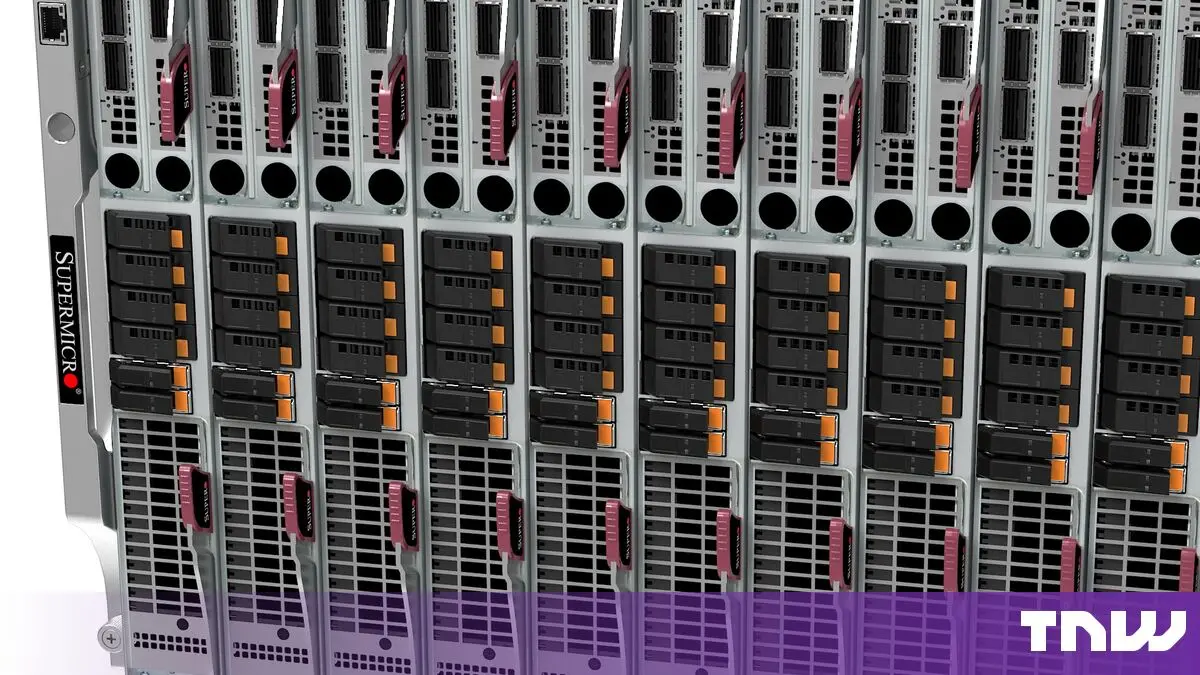
Supermicro has delivered a preliminary business update that sharply raises expectations for its latest quarter, telling investors it expects revenue of $18.5bn to $19.5bn for the three months to September. The range is far above the $14.5bn to $15.5bn the AI server maker had previously guided, with the midpoint of the new forecast sitting $4bn above the midpoint of the old one. At the midpoint, the company now expects about $19bn in revenue, compared with $15bn under its earlier forecast, an increase of roughly 27%.
The company attributed the gap to increased demand for AI platforms. It published the preliminary figures in a business update after the US market closed on Tuesday. The announcement gave investors a rare mid-quarter signal from one of the most closely watched suppliers in the AI hardware supply chain, although it was short on detail. Beyond demand and product mix, the update offered no granular explanation of what changed so quickly, and it included no executive comment.
Why the revenue beat matters
For a company of Supermicro's scale, a $4bn midpoint increase in a single quarter is substantial. It implies that orders for AI servers, rack-scale systems, and related infrastructure came in much stronger than management had assumed when it issued its original guidance. The AI server market has been volatile, shaped by the availability of advanced accelerators, networking components, power equipment, and cooling systems. Demand from hyperscale cloud providers, specialist AI cloud operators, and large enterprises has repeatedly run ahead of supply, while component constraints and rapid product transitions have made forecasting difficult.
The update suggests Supermicro is benefiting from that demand wave, but the company did not break out how much of the revenue range came from particular customers, product families, or regions. It also did not say whether the increase reflected pull-forward of orders, a change in customer delivery schedules, or simply stronger underlying demand. Those distinctions will matter when the company reports full results. A revenue beat driven by broad-based AI platform demand would be viewed differently from one driven by a small number of large orders or by timing shifts.
Supermicro is known for building high-performance servers and storage systems, and it has become a prominent supplier of AI-optimized infrastructure. Its systems are used in data centers that train and run large AI models, an area of capital spending that has remained intense even as some other parts of the technology hardware market have slowed. The company's ability to integrate servers, cooling, power, and networking into complete racks has made it a relevant player as customers seek to deploy AI clusters quickly. That position also exposes it to fast-changing customer requirements and to the operational risks that come with scaling production rapidly.
Margins beat guidance as well
The positive surprise was not limited to revenue. Supermicro said it expects a gross margin of 12.0% to 12.5% for the quarter, against guidance of 10.4% to 10.8%. The midpoint of the new range is 12.25%, compared with 10.6% under the old range, a difference of about 165 basis points. The company credited customer and product mix for the improvement.
A margin beat alongside a large revenue beat is notable because rapid growth in server hardware can sometimes pressure profitability. Large AI infrastructure deals may involve competitive pricing, complex configurations, and significant working capital requirements. A better mix can offset some of that pressure if customers buy higher-value configurations or if the company benefits from favorable product transitions. The preliminary update did not provide enough detail to determine which factors drove the improvement, but the combination of higher revenue and higher margin is likely to be a central focus for analysts.
Key facts from the update
- Preliminary revenue is expected to be $18.5bn to $19.5bn for the three months to September.
- The prior guidance range was $14.5bn to $15.5bn.
- The midpoint of the new range is $19bn, $4bn above the prior midpoint of $15bn.
- Gross margin is expected to be 12.0% to 12.5%, versus prior guidance of 10.4% to 10.8%.
- The quarter is the first of Supermicro's 2027 fiscal year.
- The company attributed the revenue gap to increased demand for AI platforms.
- It credited customer and product mix for the margin improvement.
- The figures are unaudited and have not been reviewed by the company's auditor.
- Final results may differ materially, and full results are scheduled for 3 November.
- In June, the company said it planned to raise $7bn to fill $39bn of AI server orders.
- The update follows months of headlines about AI servers smuggled to China.
The order backlog and capital raise
The size of the preliminary revenue range is easier to understand in the context of Supermicro's earlier disclosures. In June, the company said it planned to raise $7bn to fill $39bn of AI server orders. That order figure was a sign of how much demand management believed it was facing, and the capital raise underlined the working capital intensity of the business. Building and shipping large volumes of AI servers requires inventory, components, manufacturing capacity, and logistics. A company may need to fund those requirements before it collects cash from customers.
The latest update does not say whether the $39bn order figure has changed, nor does it provide an update on the capital raise. It also does not disclose how much of the expected September quarter revenue is already reflected in backlog or how much depends on deliveries scheduled late in the period. Those are important questions because preliminary revenue ranges can be affected by shipment timing, customer acceptance, and component availability. When full results are published, investors will look for details on backlog conversion, inventory levels, cash flow, and customer concentration.
Unaudited figures and the limits of the update
Supermicro was explicit that the figures are preliminary. The company said its auditor has not reviewed them and that final results may differ materially. That caveat is standard for preliminary updates, but it is especially relevant when a forecast moves by billions of dollars in a single quarter. The update also gave no detail beyond demand and mix, and it did not include a comment from an executive. As a result, investors are left to wait for the full report to understand the drivers behind the numbers.
Preliminary updates can be useful because they reduce uncertainty ahead of earnings, but they can also raise new questions. In this case, the main questions are whether the revenue beat reflects a durable increase in demand, whether it was concentrated among a small number of customers, and whether the margin improvement is sustainable. The company's full results on 3 November are expected to provide a clearer picture of revenue, profitability, and the balance sheet.
Legal and regulatory backdrop
The business update follows months of headlines about AI servers smuggled to China. Earlier this month, a fixer in the Super Micro case pleaded guilty to sending AI servers there. In June, Taiwanese authorities raided Super Micro's office in a related probe. Those developments are separate from the financial update, but they form part of the backdrop for a company operating in a sensitive area of technology trade.
AI servers and advanced accelerators are subject to export controls and compliance scrutiny in several countries. Companies that sell or distribute such equipment face complex rules and reputational risks. The latest business update did not address the smuggling headlines, and it did not provide any executive comment on the legal or regulatory matters. Investors will likely continue to monitor both the financial performance and the compliance environment as the company moves toward its full results.
What to watch on 3 November
When Supermicro reports full results, several items will be in focus. The first is the final revenue figure within the preliminary range, along with any explanation for where it landed. The second is gross margin and the mix of customers and products that shaped it. The third is cash flow and working capital, given the scale of the AI server opportunity and the capital raise announced in June. The fourth is backlog and order visibility, which will help determine whether the strong demand described in the update is likely to continue.
The company will also face questions about the $39bn order figure, the status of the $7bn capital raise, and any changes in customer demand or supply conditions. Because the preliminary update was so short, the full report may carry more weight than usual. It will be the first detailed look at how the company's AI server business performed in the quarter and how management expects the demand surge to develop.
Supermicro will report in full on 3 November.
Source: TNW | Finance News