

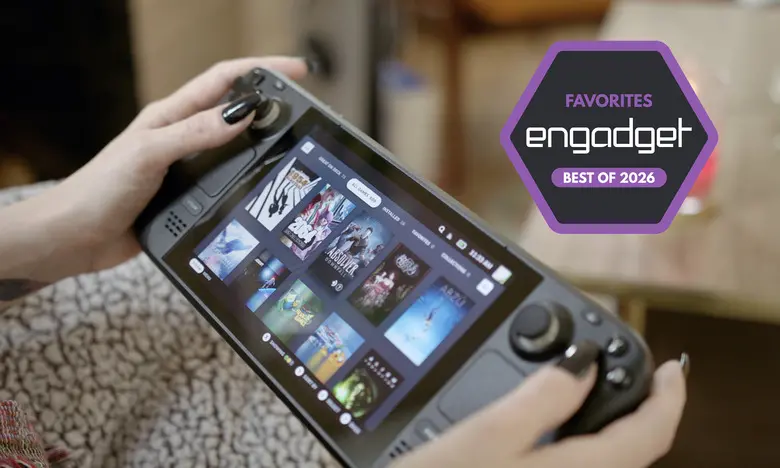
Handheld gaming systems have moved far beyond their niche roots. Today, you can choose between small emulation-focused devices, powerful portable PCs, and everything in between. That variety is exciting but makes the shopping process more complicated. The best handheld for you now depends less on a single standout product and more on how, where, and what you want to play.
Some devices are built for quick sessions and classic libraries, prioritizing simplicity, battery life, and pocket-friendly designs. Others aim to replace a laptop or desktop by packing in large screens, high-performance processors, and access to massive game catalogs, usually with trade-offs in size, price, or stamina. There are also experimental devices with unusual controls or purposefully limited experiences.
To help you navigate this crowded field, we've spent considerable time testing and tracking the latest gear. Here are the handhelds that deserve your attention in 2026.
Steam Deck: The best handheld gaming PC for most people
Valve's Steam Deck remains the best overall balance of price, performance, and usability. The Steam Deck OLED, starting at $549 with 512GB of storage, is the version worth buying if you can stretch your budget. It features a 7.4-inch HDR OLED display that is brighter, faster, and more vivid than the IPS panel on the entry-level model. The OLED screen supports HDR, higher contrast, richer colors, and a 90Hz refresh rate, making games look noticeably better. It also lasts longer thanks to a more efficient procesor and a larger battery. Valve rates the OLED model at three to twelve hours of playtime, depending on the title, while the LCD version manages two to eight hours.
The original LCD Steam Deck, now $399 with a 256GB SSD, remains a fantastic value. It offers the same core experience and access to the same library, but with a less impressive display and shorter endurance. If you want a true budget portable PC, it's still the model to get.
That said, the Steam Deck is not the most powerful machine in 2026. Some of the most demanding recent releases won't run smoothly, and Linux compatibility issues mean certain live-service games like Destiny 2 and Apex Legends are unplayable due to anti-cheat software. Still, the Deck can handle a wide range of games, from Elden Ring to Final Fantasy VII Rebirth, as well as a huge backlog of indie and older titles. SteamOS has matured into a user-friendly platform, and official Steam Verified support covers a massive list of titles. The Deck also works wonderfully with third-party tools like EmuDeck for emulating older consoles, though some systems like PS3 and original Xbox can be challenging.
The main downside is size. The Steam Deck is bulky at almost a foot long and two inches thick. The LCD model can get warm and noisy, and the d-pad is a bit mushy. But the contoured grips are comfortable, the buttons are responsive, and the dual touchpads add useful flexibility. For most people, this remains the best all-around choice.
Lenovo Legion Go S (SteamOS): Best premium handheld gaming PC
The Lenovo Legion Go S running SteamOS is the closest thing we have to a Steam Deck 2. It's the first third-party device to natively ship with Valve's operating system, delivering the same user-friendly experience with more modern hardware. The configuration we tested includes an AMD Ryzen Z1 Extreme procesor, 32GB of RAM, and a 1TB SSD. It can draw up to 33 watts in handheld mode and 40 watts when plugged in, well above the Steam Deck's 15 watts, so it offers noticeably better performance in demanding games. At equal settings, you'll often see a meaningful boost, and the extra headroom makes it easier to hit 60fps in recent AAA titles.
The device has an 8-inch LCD display with a sharp 1,920x1,200 resolution, a fast 120Hz refresh rate, and variable refresh rate (VRR) support to eliminate screen tearing. It's not an OLED panel, so colors and contrast aren't as impressive as the Steam Deck OLED, and there's no HDR. But the VRR support and extra screen space give it a real advantage for many players.
The Legion Go S is a bit heavier and chunkier than the Steam Deck, which can make it tiring to hold for long stretches. However, the rounded edges and textured grips feel comfortable, and the offset joystick layout may appeal to console players. Hall effect joysticks reduce the risk of drift, and dual USB-C ports are a welcome addition.
There are trade-offs. The Z1 Extreme version costs $900, which is expensive. The extra power means fans are louder, and while the battery is large at 55.5Whr, the Steam Deck often lasts longer, especially with lighter games. If you play a lot of resource-heavy titles and want maximum performance outside of a Windows device, the Legion Go S is worth the premium. A cheaper configuration with a Z2 Go chip, 16GB of RAM, and 512GB of storage is available for $650, but we haven't tested it yet.
ASUS ROG Xbox Ally X: Best Windows gaming handheld
If software flexibility matters more than ease of use, the ASUS ROG Xbox Ally X is the best Windows-based handheld you can buy. This $1,000 device runs Windows 11, which means it can play games from Steam, Epic, GOG, Xbox Game Pass, and other PC clients without workarounds. It also ships with a new full-screen Xbox experience that organizes games across storefronts, reduces background tasks, and makes navigating with a controller easier.
The hardware is powerful, centered on an AMD Ryzen Z2 Extreme chip with 24GB of RAM and a 1TB SSD. The Turbo mode can push the power draw to 35 watts when plugged in, giving it a clear performance advantage over the Steam Deck. The 7-inch 1080p display runs at 120Hz and supports VRR, so games stay smooth even when frame rates fluctuate. It's still a handheld, so you'll need to tweak settings, but you won't have to resort to the lowest options as often as on Valve's device.
Windows remains the double-edged sword. On one hand, you get full access to every PC storefront, and the new Xbox UI simplifies using the device. On the other, you'll still encounter familiar quirks: navigating the desktop with touch is frustrating, some settings live in separate apps like Armoury Crate, and preinstalled programs like Microsoft Teams are unnecessary. Sleep mode mostly works now, but it's not always seamless.
The Ally X is comfortable for a device this size, with a design that resembles an Xbox controller. We got about three and a half hours of gameplay in a demanding RPG with the screen at full brightness, which is solid for a Windows handheld. The speakers are loud, and the controls feel responsive. At $1,000, it's a luxury purchase, but if you're all-in on Game Pass or want the freedom of Windows in a purpose-built handheld, it's the device to get.
Retroid Pocket 5: Best mobile gaming handheld for most people
The Retroid Pocket 5, at $219, is the handheld to get if you mainly want to emulate older consoles. It runs Android and is powered by a Snapdragon 865 chip from 2020, plus 8GB of RAM. That's enough power to run most PlayStation 2 and GameCube games at full speed and sometimes at higher resolutions. We tested demanding titles like Gran Turismo 4, Ratchet & Clank: Up Your Arsenal, and F-Zero GX, and they played well with some setup. Older systems like PSP, Dreamcast, PS1, and N64 ran flawlessly at 3x to 5x resolution. The Pocket 5 can also stream games from Xbox Cloud and run native Android games like Call of Duty Mobile without issues.
Emulation on this device requires patience. You'll need to source ROM files, install the right versions of emulators, map controls, and tinker with settings. Some games won't work right without fixes. For example, we had to install a third-party GPU driver for certain Wii games and adjust display crop settings in Gran Turismo 4. If you're not willing to embrace the tinkering, this type of handheld can be overwhelming.
The hardware itself is a cut above typical budget emulation handhelds. The 5.5-inch OLED display is bright and sharp, with impressive colors. The plastic frame feels surprisingly sturdy, and the grips on the back provide a natural place for your fingers. Face buttons and triggers are comfortable, and the Hall effect joysticks should resist drift. The main design complaint is the joystick layout, which places the left stick under the d-pad and can feel awkward for newer games.
Battery life ranges from about three hours with demanding games to more than ten hours with older 8-bit and 16-bit emulation. The cooling fan is effective but can get noisy at high settings. If you're looking for a compact, capable emulation device under $300, the Pocket 5 is hard to beat.
Retroid Pocket Flip 2: A clamshell alternative
The Retroid Pocket Flip 2 is essentially the Pocket 5 in a clamshell design. It has the same Snapdragon 865 chip, the same 5.5-inch OLED display, and the same overall performance. For $229, you add a hinged protective cover and get a more compact footprint when closed. The controls are offset rather than stacked, which is more comfortable for games that rely on analog sticks. The trade-off is that the joysticks are recessed into cutouts to avoid hitting the screen, and the face buttons and d-pad feel smaller than they should be. The device is also thicker and heavier than the Pocket 5, but it's easy to toss into a bag without worrying about the screen.
AYN Odin 2: Best mobile handheld overall
If you have more to spend on an emulation-focused Android handheld, the AYN Odin 2 offers the best performance and build quality in this category. Starting at $299, it uses a Snapdragon 8 Gen 2 chip, which is a significant step up from the Retroid devices. That extra power translates to more consistent emulation: PS2 and GameCube games run smoothly at two to three times native resolution, and even 3DS and Wii titles are largely playable. The Sega Saturn, known for being difficult to emulate, is less troublesome here. You'll still need to tweak settings, but much less than on lower-powered devices.
The Odin 2 is also a more refined product. It has a 6-inch 1080p IPS display that's bright and sharp, curved grips that are comfortable to hold, and offset Hall effect joysticks. The d-pad, face buttons, and triggers all feel great. Added extras include a fingerprint scanner, a micro-HDMI port, two back buttons, and front-facing speakers. The battery is outstanding: we got more than eight hours emulating PS2 and over twenty hours with lighter tasks. The device supports 65W fast charging and can handle cloud streaming and Android games with ease.
AYN sells several variants, including a Mini model and a Portal model with an OLED display. The Mini sacrifices screen size for portability, while the Portal is larger and more expensive. Both use the same processor, so they should perform similarly. However, the standard Odin 2 remains the best overall value for serious retro gamers.
Analogue Pocket: Best Game Boy-style handheld
For those who want to play original cartridges rather than ROM files, the Analogue Pocket is the ultimate modern Game Boy. At $220, it's built like a premium version of Nintendo's classic handheld, with a gorgeous 3.5-inch LCD that has a pixel density of 615ppi. It works with Game Boy, Game Boy Color, and Game Boy Advance carts out of the box, and optional adapters allow you to play Sega Game Gear, TurboGrafx-16, Neo Geo Pocket, and Atari Lynx games.
The Pocket uses FPGA chips to recreate hardware on a circuit level, which makes its “emulation” incredibly accurate and responsive. The display can be filtered to look like various classic screens, and a microSD slot allows for software-based emulation of systems like SNES and Genesis after an update. Battery life is decent at six to ten hours, and an optional dock lets you output to a TV.
It's not a cheap device, and the shoulder buttons are a bit spongy, but the build quality is excellent. Stock shortages have also been a persistent issue. For anyone with a collection of old game cartridges, the Analogue Pocket remains the most elegant way to play them.
Playdate: Honorable mention
The Playdate from Panic is a tiny, quirky handheld with a 2.7-inch monochrome display and a crank on its side. It costs $229 and has a library of small, unusual indie games, many of which are included with the device. The hardware is charming and well-built, and battery life is around six to eight hours. The display isn't backlit, though, and the price is high for what amounts to a niche toy. But if you appreciate focused, experimental game design, the Playdate remains a fun and unique companion to a larger gaming library.
A word on the Nintendo Switch 2
The Nintendo Switch 2 is far more popular than any of the handhelds listed here, but we haven't given it a formal slot because it exists in its own category. It exists primarily to play new Nintendo games, which no other device can legally offer. Its hardware is a meaningful upgrade over the original Switch, with a larger 7.9-inch display, better performance, and magnetic Joy-Con controllers. The launch lineup includes Donkey Kong Bananza and Mario Kart World, and it can even run games like Cyberpunk 2077. However, the list of must-have exclusives is still small a few months after launch, so there's no immediate rush to buy unless you're worried about tariff-related price increases.
Other handhelds we've tested
The Lenovo Legion Go 2 is a premium Windows handheld with an enormous 8.8-inch OLED display and detachable controllers. It's built well, but it weighs over two pounds and costs up to $1,350, making it less practical than the ROG Ally X. The MSI Claw 8 AI+ is another strong Windows alternative, starting around $1,100, with 32GB of RAM and an Intel Core Ultra 7 processor. It offers solid performance, but it's expensive and its interface software is clunkier than the Xbox experience on ASUS devices.
The ModRetro Chromatic is an Analogue Pocket competitor that plays Game Boy and Game Boy Color cartridges using FPGA technology. It has a premium metal body and a bright display, but it needs three AA batteries, lacks save states, and can't play GBA games or ROMs. It also comes from a company led by an arms manufacturer founder, which may give some buyers pause. The Windows version of the Lenovo Legion Go S with the Z2 Go chip is available for $730 but underperforms compared to more expensive handhelds.
Other devices we've tested include the Ayaneo Flip DS, a dual-screen Windows handheld that's an intriguing concept but suffers from heat, poor ergonomics, and high pricing. The Ayaneo Kun is a powerful but expensive Windows handheld with an 8.4-inch display and lots of RAM, but it lacks VRR and has been superseded by newer models. The Retroid Pocket Classic is a Game Boy-style Android handheld for $129 that offers excellent value for retro emulation, while the Retroid Pocket Mini is a small 4:3 device that's nice for older games but limited for modern ones. The Retroid Pocket 4 Pro remains a decent budget option, but it's been largely replaced by the Pocket 5.
Among budget vertical handhelds, the Miyoo Mini Plus and TrimUI Brick offer good build quality for around $60–80, but their software is less polished and the Retroid Pocket Classic is worth the extra money. Anbernic's RG35XX Plus and RG35XXSP are affordable, but their stock software is rough and there have been quality control concerns with the SP's battery. The PlayStation Portal streams PS5 games over Wi-Fi and costs $200, but it's not a real handheld and requires a strong connection. The Logitech G Cloud is comfortable and has a nice display, but at $300, it lacks the performance and value of the Retroid Pocket 5.
Understanding the three tiers of gaming handhelds
The gaming handheld market can be broken into three broad groups. At the top are x86 portable gaming PCs like the Steam Deck and ROG Ally X. These offer the most power and access to modern PC games, but they're also the biggest, heaviest, and most expensive devices, often costing between $400 and $1,000 or more. Battery life is commonly short.
Below that are mobile handhelds, which run Android or Linux and cost anywhere from under $50 to $400. These are smaller and more affordable, but they can't run modern console or PC games. Most people use them for emulation through tools like RetroArch, though this often requires technical know-how and legally questionable downloads. Streaming from cloud services or your own PC is another option.
Finally, there are devices that do their own thing, like the Nintendo Switch 2 and Playdate. They run specialized systems and offer unique game libraries. They may not have the widest appeal, but they're often the easiest for less technical users to pick up and start playing.
The handheld space continues to evolve rapidly. As new chips appear and more devices ship with SteamOS or improved versions of Windows, your choices will only expand. Whatever kind of gaming you enjoy, there is likely a handheld in 2026 that fits the way you play.
Source: Engadget News