

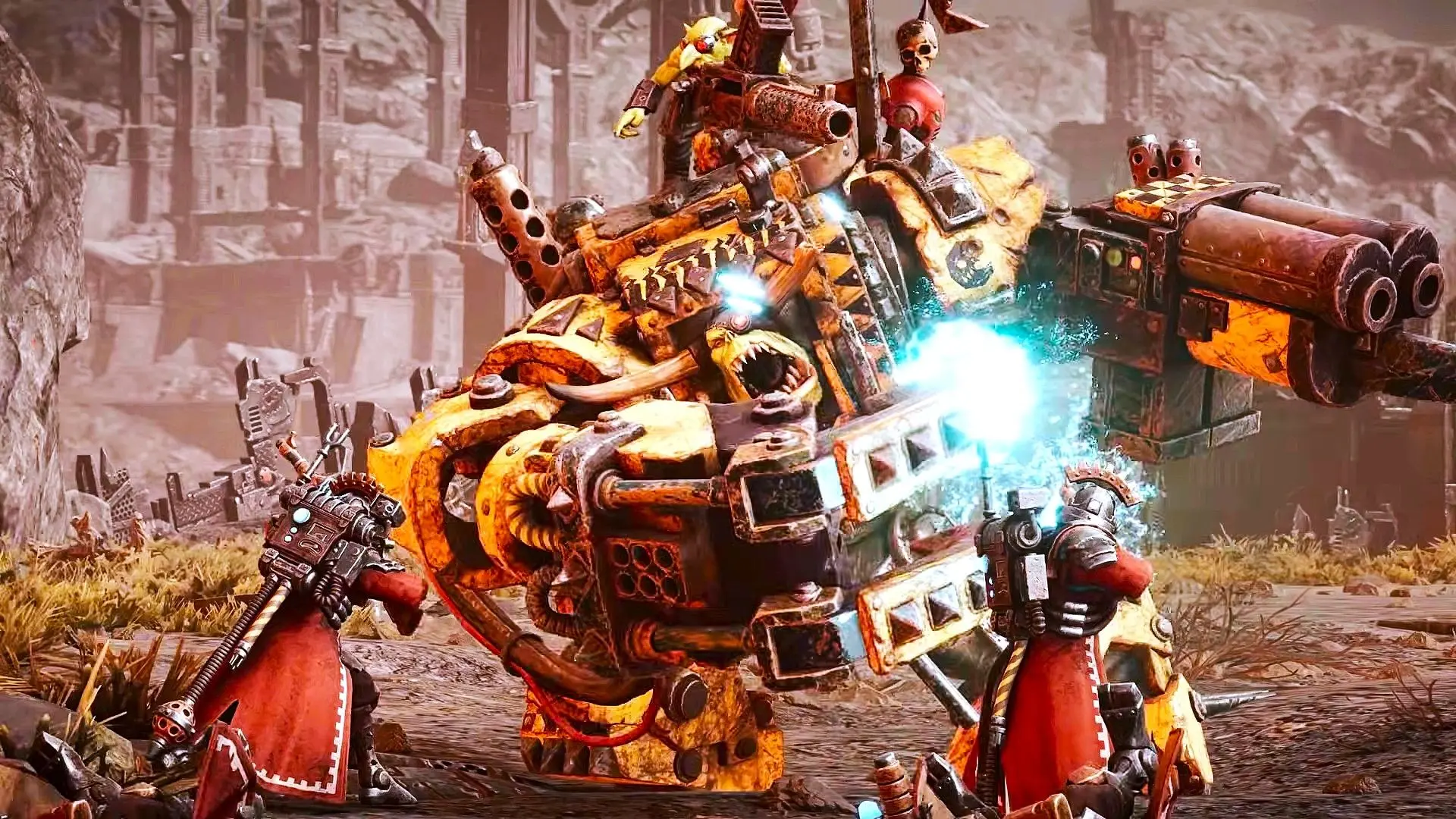
Fresh gameplay footage for Warhammer 40,000: Dawn of War IV has finally arrived, and the campaign mode is the clearest statement of intent yet. The reveal does not treat the single-player experience as a side attraction or a tutorial wrapper for multiplayer. Instead, it places a structured, choice-driven campaign at the center of the game's identity, with large-scale battles, faction-specific units, and mission design that appears to reward planning rather than pure speed. For a real-time strategy series with a long and demanding audience, that is exactly the right note to strike.
The footage has already had a measurable effect on interest. The game has moved onto wishlists, and the reason is not difficult to understand. Dawn of War IV is being presented as a strategy game that understands why players return to the 40,000 universe: not only for spectacle, but for the feeling of commanding an army that has been built, shaped, and committed to a battlefield with consequences. The campaign mode is where that promise is being tested most directly.
Campaign Mode Takes Center Stage
The most striking part of the gameplay reveal is how much attention the campaign receives. The footage suggests a mode built around a sequence of missions that are connected by more than a menu screen. Decisions appear to carry forward, armies seem to matter between battles, and the objectives are framed as part of a wider war rather than isolated skirmishes. That structure gives the campaign a sense of momentum. Players are not simply clearing maps; they are managing a front.
That distinction is important. A strong RTS campaign needs to teach systems without feeling like a tutorial, and it needs to provide variety without losing the core loop of base building, army composition, and battlefield control. The reveal points toward a campaign that does both. Some missions appear to emphasize defense and fortification. Others lean on rapid strikes, objective capture, or the careful use of a small number of elite units. The result is a campaign that can flex around the fiction instead of forcing every battle into the same shape.
What the Gameplay Footage Shows
The gameplay footage is built around the familiar rhythm of real-time strategy, but the presentation makes the scale clear. Armies move in formation, battlefields are layered with cover and chokepoints, and the camera pulls back far enough to show how quickly a plan can collapse. There is spectacle in the reveal, but the more important detail is the number of decisions visible at once. Resource capture, unit preservation, ability timing, and map control all appear to be part of the same conversation.
- Large-scale battles that emphasize positioning and timing rather than a single rush.
- Campaign decisions that appear to shape the wider war and the tools available to the player.
- Distinct faction identities, with unit rosters and abilities that look designed to create different playstyles.
- Mission variety that ranges from defensive stands to aggressive pushes and objective-driven engagements.
The footage also makes a case for readability. In a large RTS, visual noise can ruin the experience. The reveal appears to use strong silhouettes, clear unit groupings, and readable ability effects so that players can understand what is happening even when the screen fills with infantry, vehicles, and explosions. That may sound like a technical detail, but it is central to whether a campaign can support ambitious missions without becoming frustrating.
The Campaign Is More Than a Tutorial
The campaign mode has become the headline because it appears to be treated as a full game in its own right. The reveal suggests a structure in which players build a force, make choices about how it develops, and then take that force into missions that test different parts of the strategy layer. That is a meaningful shift from campaigns that reset the player's progress every mission. A persistent roster can create attachment. It can also create tension, because losses matter and every upgrade represents a commitment.
That approach fits the setting. Warhammer 40,000 is a universe of grinding attrition, desperate stands, and costly victories. A campaign that carries those ideas into the mechanics has a better chance of feeling authentic than one that simply uses the imagery as a backdrop. The gameplay reveal does not need to explain every system to make that point. It only needs to show that the campaign has weight.
Large-Scale RTS Combat Returns to the Forefront
Dawn of War IV is arriving at a time when real-time strategy fans are hungry for games that combine scale with clarity. The genre has never lost its audience, but the space between fast-paced skirmish games and elaborate management simulations is narrower than it once was. The reveal positions this game in that middle ground. It looks approachable enough to follow, but detailed enough to reward players who want to think about build orders, scouting, and counterplay.
Base building appears to remain part of the formula, which will matter to players who associate the series with the tension of expanding while under pressure. The footage also suggests that map control will not be a background detail. Capturing and holding territory creates the economy that supports larger armies, which in turn creates the risk of overextending. That loop is the heart of classic RTS design, and the campaign appears to be using it as the foundation for mission objectives rather than treating it as a separate multiplayer concern.
Faction Identity and Battlefield Readability
The reveal leans heavily on faction identity. Different armies are not presented as cosmetic skins over the same core roster. They have distinct silhouettes, weapon rhythms, and abilities that communicate how they are meant to be played. That matters for both the campaign and any future competitive mode. A strategy game lives on asymmetry, but asymmetry only works when players can understand what they are looking at and make a reasonable response.
The footage appears to balance that tension by keeping the visual language grounded. Unit types read clearly, elite units stand out without becoming invisible under effects, and the battlefield has enough structure for players to form a plan. The campaign can then use those readable pieces to create more complex encounters. A defensive mission can introduce a new enemy type. A later mission can combine that enemy type with terrain and timing to force a different response. That is how a campaign teaches without stopping the action for a lecture.
Why the Wishlist Reaction Makes Sense
The wishlist momentum around Dawn of War IV is not just a reaction to a logo or a cinematic tease. It is a reaction to seeing the game in motion and understanding what kind of experience it is trying to deliver. The campaign mode is central to that understanding because it gives the reveal a narrative shape. Players can imagine the missions, the army progression, and the decisions that will connect one battle to the next.
There is also a practical reason for the interest. A strong campaign is often the deciding factor for players who prefer strategy games as a single-player experience. They want a reason to learn the systems, a structure that introduces factions and units over time, and missions that feel designed rather than generated. The reveal suggests that Dawn of War IV is taking that audience seriously. That does not guarantee quality, but it explains why the footage has moved the game onto so many wishlists.
The Strategy Layer Behind the Spectacle
What separates a memorable RTS from a forgettable one is often the layer beneath the explosions. The reveal hints at that layer through the way units are grouped, the way objectives are placed, and the way the camera lingers on the battlefield after an engagement. Those choices suggest that the campaign will ask players to manage resources, protect key units, and decide when to commit rather than simply build the largest possible army.
Army composition appears to be a major part of that equation. The footage shows mixed forces engaging across different ranges, which implies a need for screening units, ranged support, and vehicles that can break a stalemate. That kind of design creates room for mastery. It also creates room for failure, which is essential. A campaign that never pushes back is a campaign that never teaches.
What Remains Unknown
The reveal leaves several important questions unanswered. Release timing, platform details, multiplayer structure, and the full faction lineup are all still part of the larger picture. That uncertainty is normal at this stage, but it also means the campaign footage is doing a lot of work. It has to establish confidence before the marketing machine fills in the blanks. On that front, the reveal succeeds because it shows a clear point of view rather than a generic montage.
The bigger question is whether the full game can sustain the promise of the campaign over many hours. A strong first look can show scale, atmosphere, and intent. It cannot show pacing, mission variety across an entire campaign, or whether the progression systems remain interesting after the novelty of the first few battles wears off. Those are the details that will decide whether Dawn of War IV becomes a lasting strategy favorite or a brief return to a beloved name.
The Pressure of a Beloved Name
Any new Dawn of War game carries expectations that go beyond the usual genre checklist. The series has a history, and its audience has strong opinions about what a sequel should preserve and what it should change. The reveal seems aware of that balance. It leans on the scale and faction identity that fans expect, while putting the campaign forward as the reason to care. That is a sensible strategy. It gives newcomers a clear entry point and gives longtime players a reason to believe the single-player experience has not been treated as an afterthought.
For now, the gameplay reveal has done enough to make Dawn of War IV one of the real-time strategy projects to watch, with the campaign mode leading the charge and wishlist interest following close behind.
Source: Windows Central News