

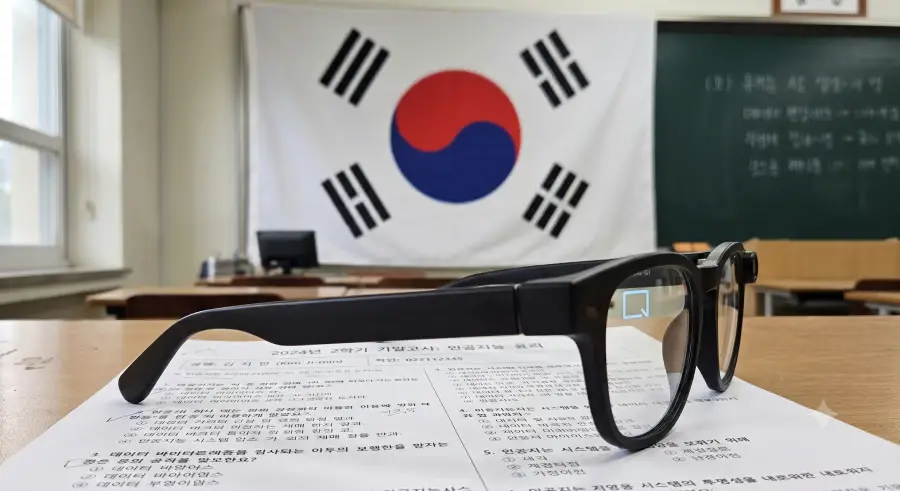
Smart glasses have entered South Korea&8217;s exam rooms, and prosecutors are now taking legal action. The Gwangju District Prosecutors&8217; Office filed the country&8217;s first criminal charge tied to cheating using AI-powered smart glasses after a man in his 40s allegedly used the device during a fire protection facilities engineer exam. Authorities allege he connected the glasses to an AI application that generated answers during the test, a move that could reshape how testing organizations handle wearable technology.
The Incident in Detail
The incident occurred on May 15, 2026, in Gwangju, a major city in southwestern South Korea. The test-taker was taking the national fire protection facilities engineer certification exam when a proctor noticed something unusual. According to reports, a suspicious light reflected from the lenses of the man&8217;s glasses, and he repeatedly fixed his gaze in one direction, even when not solving questions. This behavior prompted the supervisor to alert authorities. After an investigation, prosecutors discovered that the suspect had developed a custom AI application that paired with his smart glasses. The app was designed to process questions and provide real-time answers, essentially turning the glasses into a cheating device.
During questioning, the suspect reportedly told investigators, &8220;I developed an AI application that works with the smart glasses and wanted to see whether it could generate correct answers in a real exam.&8221; The statement highlights a growing trend where individuals exploit emerging technology to bypass traditional exam security. The prosecutors requested a fine through a summary indictment, a procedure that allows a court to issue a penalty based on written review without a formal trial. However, if the defendant or the court objects, the case could proceed to a full trial.
Broader Context: A Wave of AI Glasses Cheating
The Gwangju incident is not isolated. South Korean media have reported multiple similar cases in recent months. In Seoul and Mokpo, two men in their 20s were booked after allegedly attempting to cheat with AI-powered smart glasses at national qualification exam sites. Additionally, TOEIC testing centers have also been affected, with two individuals caught in May and another in June. These incidents have alarmed testing agencies and prompted emergency discussions. On July 10, officials from major national qualification exam bodies held a meeting to address the problem. Key topics included explicitly adding AI smart glasses to lists of prohibited devices and increasing sanctions for those caught using them.
The rise of such cheating methods is linked to the proliferation of advanced wearable technology. AI-powered smart glasses, such as those from Meta and other companies, now include microphones, cameras, displays, and virtual assistants. They can be designed to look like ordinary eyewear, making them difficult to detect. In exam settings, these devices can receive and transmit information, allowing test-takers to access external databases or AI models that generate answers in real time. This represents a significant leap from traditional methods like hidden earpieces or written notes.
Legal and Security Implications
South Korea&8217;s response to these incidents could set a precedent for how the Asia-Pacific region handles wearable AI in educational and professional environments. The country&8217;s National Technical Qualifications Act, under which the charge was filed, provides a legal framework for penalizing cheating. However, the law was written before the advent of AI smart glasses, and updates may be needed to address new technologies. The case also raises questions about enforcement. Proctors and invigilators must now be trained to identify suspicious behavior associated with smart glasses, such as unusual reflections, repeated eye movements, or fixed gazes. Testing centers may need to invest in detection equipment or establish clearer rules about what wearable devices are allowed.
Beyond exam halls, the business impact is significant. Employers, certification bodies, and training providers rely on test results to verify skills and qualifications. Weak controls could undermine trust in professional credentials. For example, engineers, accountants, and healthcare professionals often need to pass rigorous exams to obtain licenses. If cheating becomes widespread, it could devalue these certifications. On the other hand, overly broad restrictions could penalize legitimate users who require smart glasses for vision correction or other disabilities. Testing organizations must balance security with accessibility and privacy concerns.
Technological Countermeasures and Industry Response
In response to these challenges, some testing organizations are exploring technological countermeasures. For instance, they may use signal detectors to block wireless transmissions, or employ AI-based monitoring systems that analyze test-taker behavior in real time. Another approach is to redesign exam formats to reduce the effectiveness of smart glasses, such as moving to situational judgment tests or oral presentations. However, these solutions are not foolproof and can raise privacy issues. As AI-powered smart glasses become more common, the arms race between cheaters and security systems will likely intensify.
The case in South Korea also highlights the need for international cooperation. Many professional certifications are recognized across borders, and a cheating scandal in one country could affect the credibility of certifications worldwide. Organizations such as the Asia-Pacific Testing Association may need to develop common guidelines for dealing with wearable technology. Additionally, manufacturers of smart glasses could be pressured to implement safeguards, such as disabling camera or AI functions in exam settings.
Background on AI Smart Glasses and Cheating Trends
The use of smart glasses for cheating is a recent phenomenon, driven by advances in artificial intelligence and miniaturization. In the past, cheating involved hidden cameras, radio transmitters, or mobile phones. Smart glasses offer a more discreet option because they can be worn continuously without arousing suspicion. Some models now include bone conduction audio, allowing users to receive answers without any visible earphones. The Meta Ray-Ban Stories and later models have popularized the concept, but similar products from other manufacturers are also entering the market. As the technology becomes cheaper and more accessible, the temptation to use it for cheating may grow.
South Korea is particularly vulnerable because of its high-stakes education system. National exams, such as the College Scholastic Ability Test (CSAT) and various professional certification tests, are critical for career advancement. The pressure to succeed can drive some individuals to extreme measures. The government has long struggled with cheating scandals, including the use of hidden cameras and cell phones. The emergence of AI smart glasses adds a new dimension to this challenge.
Impact on the Asia-Pacific Region
The implications of South Korea&8217;s first criminal charge extend beyond its borders. Other countries in Asia-Pacific, including Japan, China, Taiwan, and Singapore, have similar high-stakes testing environments. These nations are likely to monitor South Korea&8217;s response closely. Some may already be experiencing similar incidents. For example, in China, AI-powered glasses have been used in postgraduate entrance exams, leading to arrests. Japan has also reported cases of cheating with smartwatches and earbuds. As the technology becomes more sophisticated, regional cooperation on security measures will become essential.
Testing organizations in APAC may need to update their policies to explicitly ban AI wearables, provide better training for proctors, and adopt more advanced screening procedures. They also need to account for prescription eyewear, disability accommodations, and privacy concerns before implementing intrusive checks. The goal is to create a level playing field where candidates are assessed fairly and credentials remain trustworthy.
The Gwangju prosecution may discourage some attempts, but legal action alone will not solve the problem. As AI-powered smart glasses become more common, testing systems must evolve continuously. The case in South Korea is a wake-up call for educational institutions, certification bodies, and governments across the region.
Source: eWeek News