

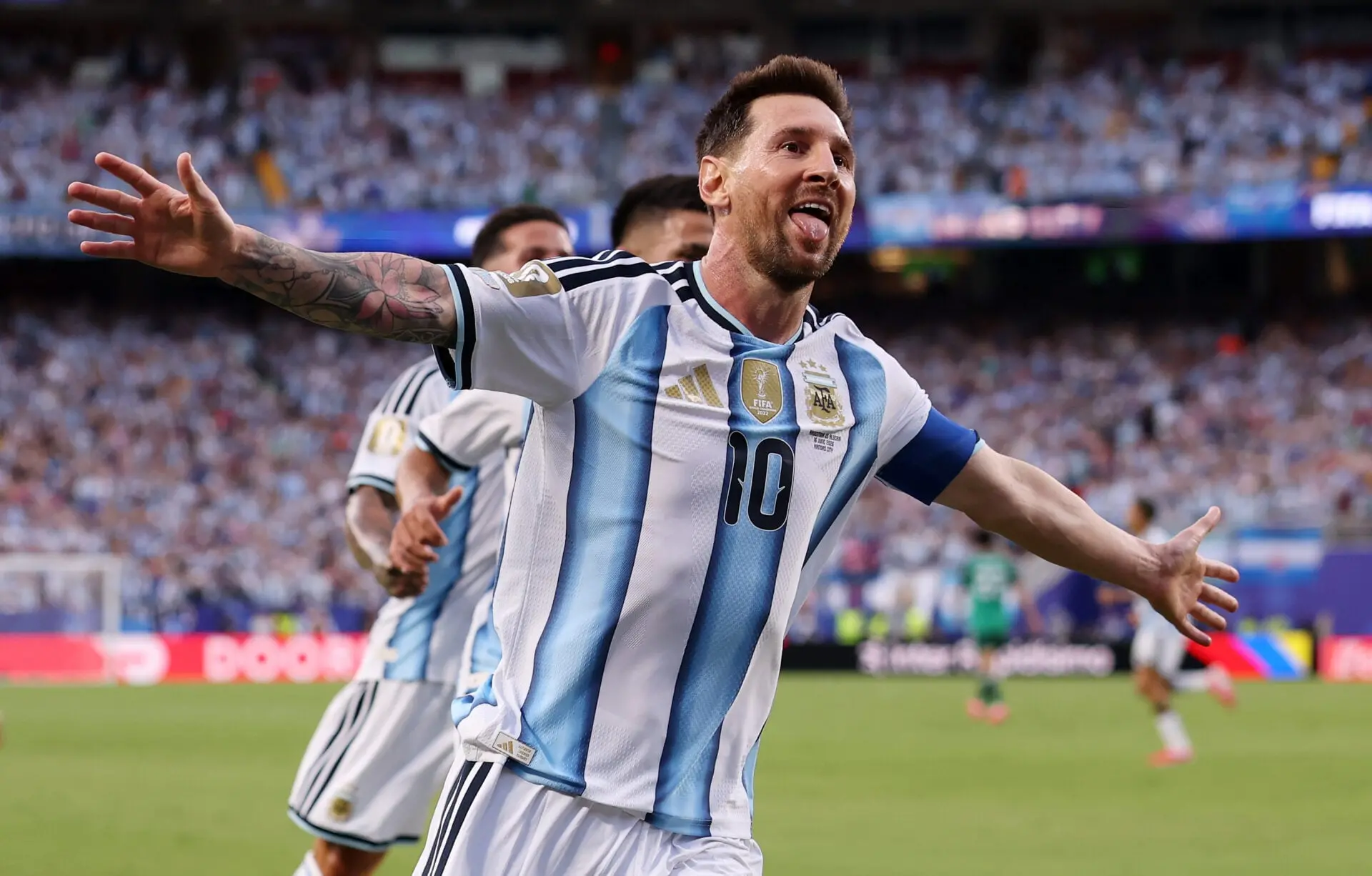
When Lionel Messi stepped onto the pitch for Argentina at the 2022 FIFA World Cup in Qatar, fans and commentators alike noticed something unusual about his jersey. Unlike any other player in the tournament, Messi’s shirt featured four small gold patches stitched near the collar. These patches were not merely decorative; they carried profound meaning, celebrating a career of unmatched achievement on the international stage.
The four gold patches symbolize the four major international trophies Messi has won with Argentina: the 2022 World Cup, the 2021 Copa America, the 2022 Finalissima (the intercontinental cup between Copa America and European champions), and the 2008 Olympic gold medal. This quartet of honors places Messi in a category of his own — no other active player has collected such a complete set of titles at both senior and youth levels. The patches serve as a permanent reminder of his legacy, and FIFA approved them as a special tribute to Messi’s unique accomplishments.
The Story Behind the Gold Patches
The idea for the gold patches originated with the Argentine Football Association (AFA) and was submitted to FIFA for approval before the World Cup. According to officials, the patches were designed to represent Messi’s four FIFA recognized international titles. The gold color was chosen deliberately to contrast with the traditional blue and white stripes of Argentina’s home kit, making the patches stand out during broadcasts and photographs. Each patch is approximately two centimeters in diameter and features a miniature gold star, a nod to the stars on a national team’s crest that denote World Cup victories.
Interestingly, while many national teams display stars above their crests for each World Cup win (Argentina has three: 1978, 1986, 2022), Messi’s personal patches include competitions beyond the World Cup. This distinction has led to some debate among fans and analysts about whether such personalization should be allowed in a team sport. However, FIFA’s approval signaled a recognition of Messi’s individual impact on the global game, especially as he was about to lead Argentina to its third World Cup triumph.
Messi’s Road to Four Titles
To understand why Messi is the only player with four gold patches, one must appreciate the rarity of his trophy collection. The Olympic gold medal in 2008 was Messi’s first major international honor. Playing alongside players like Angel Di Maria and Juan Roman Riquelme, Argentina defeated Nigeria 1-0 in the final, with Messi providing a crucial assist. That win established Messi as a young star capable of delivering on the global stage.
The Copa America victory in 2021 was perhaps the most emotional. Messi had previously lost three Copa finals (2007, 2015, 2016) and was often criticized for failing to win with Argentina. In Brazil, he scored four goals and provided five assists, winning the Golden Ball as the tournament’s best player. The 1-0 final win over Brazil at the Maracana Stadium ended a 28-year trophy drought for Argentina and cemented Messi’s legacy in his homeland.
The Finalissima in 2022 was a one-off match between Copa America champions Argentina and Euro 2020 winners Italy. Argentina won 3-0 in London, with Messi scoring once and setting up another goal. It was a historic game because it marked the first time Argentina faced and defeated a European champion in an official FIFA-recognized cross-confederation final. That victory added a third gold patch to Messi’s collection.
Then came the 2022 World Cup in Qatar. Argentina’s campaign was a roller coaster: an opening defeat to Saudi Arabia, followed by dominant wins, and a nail-biting final against France that ended 3-3 after extra time and went to penalties. Messi scored two goals in the final and converted his penalty in the shootout, finally lifting the trophy that had eluded him. The fourth gold patch was now assured, and FIFA allowed the patches to be worn immediately after the final whistle.
Why No Other Player Has Four Patches
The combination of these four specific titles is almost impossible for any other contemporary player to replicate. First, the Olympic football tournament is limited to players under 23 (with three overage exceptions), and many top players either skip it or are not selected. For example, Cristiano Ronaldo has never won an Olympic medal. Kylian Mbappe has a World Cup but no Copa America or Olympic gold. Neymar won the Olympic gold in 2016 with Brazil and the Copa America in 2019, but he has not won a World Cup or a Finalissima. Similarly, players from European nations cannot win a Copa America, and South Americans cannot win the Euros, so the Finalissima is uniquely accessible only to champions from the two continents. Furthermore, Messi became the first player to win the Golden Ball at a World Cup after turning 30, but that award is not represented by the patches — the patches strictly count the international trophies themselves.
Another factor is longevity. Messi has been playing for Argentina since 2005, spanning nearly two decades. He has participated in five World Cups, six Copas América, two Olympic tournaments (though only as a youth), and the one-off Finalissima. Few players have the career length and consistency to accumulate such a haul. Additionally, Messi’s leadership role — he has been captain since 2011 — meant he was the face of every campaign, which may have influenced FIFA’s willingness to grant the personalized patches.
The Design and Symbolism
The patches themselves are simple yet elegant: a gold circle with a single gold star in the center, surrounded by a thin gold ring. On close inspection, the inner star is embossed with a subtle pattern resembling a laurel wreath, a classic symbol of victory. The patches are placed in a vertical column on the left side of the jersey, just below the collar and above the AFA crest. During the World Cup, cameras often zoomed in on Messi during anthem ceremonies, and the patches glinted under the stadium lights, drawing attention from millions of viewers worldwide.
For Argentine fans, the patches became a source of pride. Many replica jerseys sold out within hours of Messi’s first appearance in Qatar, with fans eager to own a piece of history. Even rival fans acknowledged that the patches were a fitting tribute to a player who had redefined the sport. Social media buzzed with images of the patches, and memes comparing Messi’s gold patches to other players’ blank jerseys went viral.
FIFA officials later clarified that the patches were a one-time concession for Messi, not a new precedent for future tournaments. “The four gold patches are a unique honor for a unique player,” a FIFA spokesperson said. “We do not expect to approve similar requests for other players in the foreseeable future.” This statement reinforced the exclusivity of Messi’s achievement and ensured that his jersey will remain a collector’s item for generations.
Historical Context: Past Special Jerseys in World Cup History
Messi is not the first player to wear a customized jersey in a World Cup. In 1986, Diego Maradona wore a shirt with a subtle personal message, though it was not officially sanctioned. In 2014, Germany’s players wore stars above the crest for their World Cup win in 2014, but those were standardized for the whole team. In 2018, France’s Didier Deschamps wore a special suit jacket, but not a jersey. The closest parallel might be the gold boots worn by several players after winning the Golden Boot award in a tournament, but those are footwear, not patches.
Messi’s patches, however, are permanent additions to the kit for the entire tournament, not just for a specific award ceremony. This level of personalization is unprecedented, and it underscores how Messi’s career has transcended typical team sports decorum. Some purists argue that individual accolades should not be displayed on a team jersey, but the overwhelming response has been positive, with many praising FIFA for recognizing Messi’s contributions to football history.
Interestingly, the patches also sparked a trend. In the months following the World Cup, several amateur and youth teams around the world began using similar patches to celebrate their players’ achievements. However, FIFA quickly reminded clubs that such patches require official approval and that unauthorized use could contravene tournament regulations. This only added to the mystique of Messi’s four patches.
Messi’s Legacy Beyond the Patches
While the gold patches are a tangible symbol of Messi’s success, they also represent something deeper: the fusion of individual brilliance with collective triumph. For years, Messi was criticized for not winning major trophies with Argentina, despite his Barcelona heroics. The patches effectively silence that criticism, as they reflect four distinct team victories where Messi played a central role. His 2021 Copa America win was particularly celebrated because it ended a long drought; his 2022 World Cup win elevated him to the pantheon of all-time greats alongside Maradona and Pelé.
Beyond the trophies, the patches are a conversation starter. They prompt discussions about which international titles are most valuable, how FIFA should recognize individual achievements, and whether future generations of players can match Messi’s international haul. Already, young stars like Kylian Mbappe and Erling Haaland are being compared to Messi, but neither has an Olympic gold nor a Copa America. The patches serve as a benchmark that will be difficult to surpass.
For now, Messi’s four gold patches remain an exclusive club of one. As he continues to play for Argentina beyond the 2022 World Cup, there is speculation that if he wins another major title — perhaps the 2024 Copa America or the 2026 World Cup — a fifth patch might appear. But FIFA has not commented on whether the patch system will be extended. Regardless, the four patches are already etched in football lore, a shiny reminder that sometimes, one player can truly stand alone.
Source: HITC News