

The New Era of AI-Driven Software Development
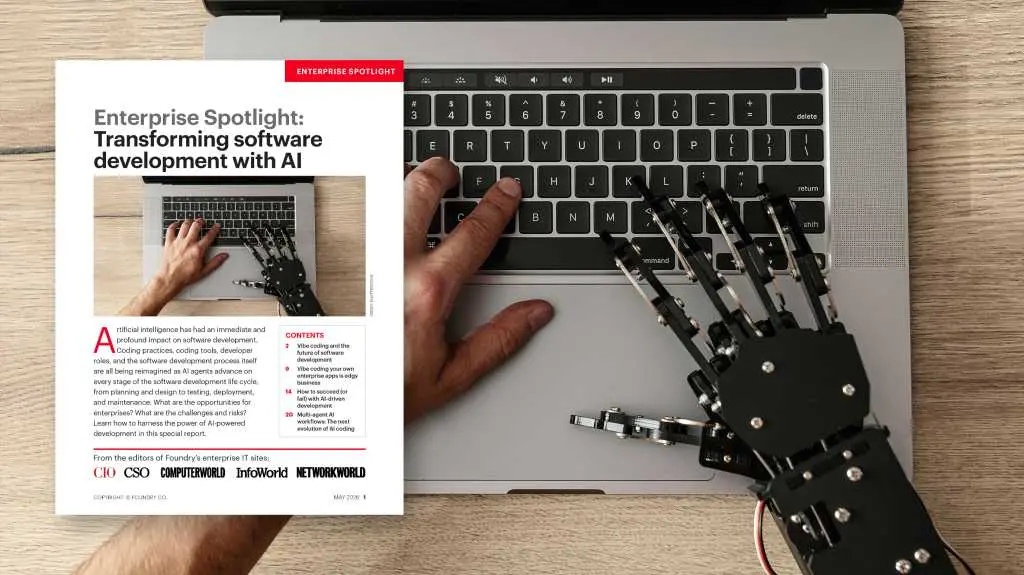
Artificial intelligence has had an immediate and profound impact on software development. Coding practices, coding tools, developer roles, and the software development process itself are all being reimagined as AI agents advance on every stage of the software development life cycle, from planning and design to testing, deployment, and maintenance. The May 2026 Enterprise Spotlight, a collaborative issue from the editors of CIO, Computerworld, CSO, InfoWorld, and Network World, dives deep into this transformation, offering practical guidance for enterprises looking to harness the power of AI-enabled development.
This is not a future trend; it is happening now. According to recent surveys, over 70% of developers have used AI coding assistants in some capacity, and that number is growing rapidly. The shift is comparable to the transition from assembly language to high-level languages, or from waterfall to agile methodologies. But the speed of adoption is unprecedented. AI is not merely an automation tool—it is fundamentally changing how software is conceived, built, tested, and maintained.
The Evolution of AI in Software Development
To understand the current state, it helps to look back. Early AI in coding involved rule-based systems and simple autocomplete. The 2010s saw the rise of machine learning for bug prediction and code review. But the breakthrough came with large language models (LLMs) like GPT-3 and Codex, which could generate entire functions based on natural language prompts. By 2024-2025, code generation tools such as GitHub Copilot, Amazon CodeWhisperer, and Google's Gemini for Code became mainstream, integrating directly into IDEs and CI/CD pipelines.
Today, AI agents are moving beyond code generation. They can autonomously plan architecture, generate tests, debug errors, and even deploy applications. The Enterprise Spotlight captures this evolution, detailing how organizations from startups to Fortune 500s are adopting AI agents across the entire SDLC.
Key Areas of Transformation
Planning and Design
AI now assists in requirements analysis and system design. Tools like IBM Watson and specialized LLMs can parse user stories, identify inconsistencies, and suggest optimal architectures. For example, an AI might recommend a microservices pattern based on the scale and latency requirements of an e-commerce application. This reduces design time by up to 40% in some studies.
Coding and Pair Programming
The most visible impact is on coding. AI-powered pair programming tools act as always-available junior developers, suggesting completions, entire functions, and even refactoring code. They learn from the codebase and adapt to coding standards. However, challenges remain: AI-generated code can introduce security vulnerabilities or subtle logic errors, requiring careful review. The Enterprise Spotlight discusses best practices for integrating these tools without sacrificing code quality.
Testing and Quality Assurance
AI is revolutionizing testing by automatically generating test cases, identifying code paths that are likely to fail, and simulating user behavior. Continuous testing frameworks now incorporate AI to prioritize tests based on recent changes, reducing feedback loops from hours to minutes. For security testing, AI can simulate attacks and detect anomalies in real-time, helping prevent breaches.
Deployment and Maintenance
AI agents manage canary releases, rollbacks, and infrastructure provisioning. They can predict system failures and automatically scale resources. In maintenance, AI analyzes logs and metrics to diagnose issues proactively, sometimes even applying patches before a human notices a problem. This shift from reactive to proactive maintenance is one of the most transformative aspects.
Shifting Developer Roles
With AI handling routine coding and testing, developer roles are evolving. The demand for pure coders is decreasing, while the need for architects, domain experts, and AI orchestration specialists is rising. Developers must now understand prompt engineering, know how to validate AI outputs, and be able to integrate multiple AI agents into a coherent pipeline. The report emphasizes that soft skills—communication, problem-solving, and ethical reasoning—are becoming as important as technical skills.
Many companies are creating new roles like "AI Software Engineer" or "LLM Operations Manager." The traditional career ladder is being redefined, and the Enterprise Spotlight provides case studies from organizations that have successfully reskilled their workforce.
Challenges and Risks
Despite the promise, AI in software development is not without risks. The most pressing concerns include:
- Hallucinations and incorrect code: LLMs can generate plausible but factually wrong code, leading to hard-to-find bugs.
- Security vulnerabilities: AI might produce code with known security flaws if trained on outdated or insecure examples.
- Bias and fairness: AI models can perpetuate biases present in training data, affecting critical systems like banking or healthcare.
- Intellectual property concerns: Questions about ownership of AI-generated code remain unresolved in many jurisdictions.
- Over-reliance: Teams that trust AI blindly may miss important edge cases or fail to understand the system they are building.
The report covers mitigation strategies: using rigorous code review, implementing AI governance frameworks, training datasets carefully, and maintaining human oversight at critical decision points.
The Enterprise Spotlight Report: A Roadmap
The May 2026 Enterprise Spotlight is a comprehensive resource for organizations at any stage of AI adoption. It includes:
- Detailed profiles of leading AI coding assistants and their enterprise capabilities.
- Step-by-step guides for integrating AI into existing DevOps pipelines.
- Interviews with CTOs and engineering leaders who have successfully deployed AI agents at scale.
- A risk assessment matrix to help teams decide which tasks are safe to delegate to AI.
- Predictions for the next 12-18 months, including the rise of multi-agent systems and AI-powered self-healing applications.
One standout example cited is a financial services firm that reduced time-to-market for new features by 60% using an AI-assisted development pipeline, while maintaining regulatory compliance through automated auditing. Another is a healthcare startup that used AI to generate HIPAA-compliant code, dramatically reducing legal risks.
Preparing for the Future
As AI continues to evolve, the boundaries of what is possible will expand. The Enterprise Spotlight emphasizes that the organizations that succeed will be those that treat AI as a collaborator, not a replacement. They will invest in upskilling their teams, establishing ethical guidelines, and continuously evaluating new tools. The report concludes with a call to action: start small, experiment often, and build a culture of experimentation and learning.
For those ready to dive deeper, the full Enterprise Spotlight issue is available for download. It offers actionable insights that can help any organization navigate the complex but rewarding journey of AI-enabled software development. From rethinking role definitions to implementing governance, the path forward is clear: embrace AI, but with eyes wide open to its capabilities and limitations. The transformation is here, and it is reshaping the very foundation of how we build software.
Source: Network World News