

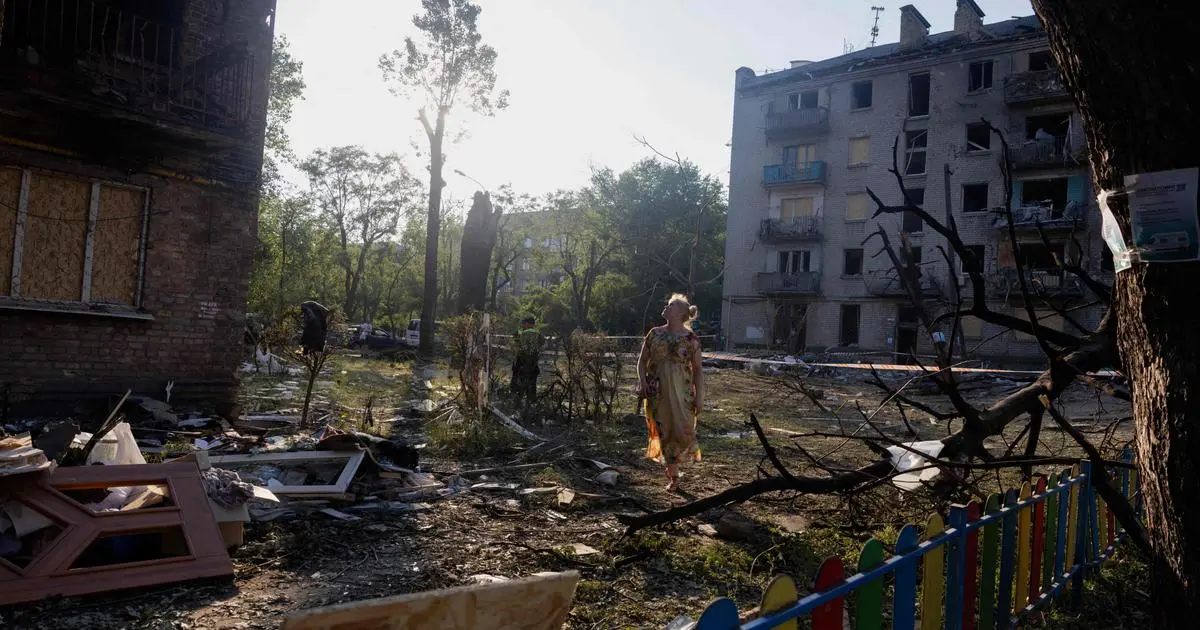
Ukraine: Zelensky Promises Riposte After ‘Most Massive’ Russian Attack on Kyiv
Ukraine’s President Volodymyr Zelensky vowed a swift and forceful response after Russia launched its largest aerial assault on Kyiv since the war began in 2022. The attack, which occurred overnight on July 2–3, 2026, involved 74 missiles and 496 long-range drones, according to the Ukrainian air force. Forty-eight missiles and 476 drones were intercepted, but 25 ballistic missiles and 12 drones struck 33 sites across the capital and its region. The assault left at least 27 dead and 91 wounded, with damage reported in every district. Rescue operations continued through the day, indicating the toll could rise.
Zelensky, who cut short a visit to Dublin for the launch of Ireland’s EU presidency, visited several bombed sites. “If our partners had kept their promises on time, we could have saved more homes and lives today,” he said, visibly fatigued and frustrated. He specifically urged the United States to grant Ukraine licenses to produce Patriot missile defense systems, a request highlighted by the BBC. The Ukrainian leader also called for more air defense systems ahead of an upcoming NATO summit in Ankara. Meanwhile, the Russian Defense Ministry stated it would continue to “increase pressure on the Kiev regime to achieve its goals.” The attack comes as Ukraine has increasingly struck targets inside Russia using domestically built long-range drones and cruise missiles, complicating Russian logistics and causing fuel shortages. The New York Times noted that this capability has not yet deterred President Vladimir Putin from pursuing the war.
Vatican: Pope Leo XIV Excommunicates Six Traditionalist Bishops
In a decisive move, Pope Leo XIV issued a decree excommunicating six bishops from the Society of St. Pius X (SSPX), the traditionalist Catholic movement founded by Archbishop Marcel Lefebvre. The excommunication was triggered by the consecration of four new bishops on June 29, 2026, in Ecône, Switzerland, without papal approval. The Dicastery for the Doctrine of the Faith declared the act “schismatic,” leading to the automatic excommunication of the four new bishops and the two existing SSPX bishops. The decree also warned lay Catholics that adherence to the schism would result in their own excommunication. The SSPX, which broke with Rome in 1988 over opposition to the Second Vatican Council, operates in over 70 countries, with about 700 priests and 600,000 faithful. The group rejects the modernizing reforms of the Church, including the decline of the Latin Mass, and advocates for a traditionalist, theocratic model of society. The Corriere della Sera reported that the Vatican’s concise, direct decree avoided lengthy preamble, signaling a firm stance against the rebellion.
Monaco: Suspect Identified in Package Bomb Attack on Ukrainian Businessman
Investigators in Monaco have identified a suspect in the attempted assassination of Ukrainian-born businessman Vadim Ermolaev. A Europe-wide arrest warrant was issued, and Interpol was alerted. The attack occurred on June 29 when a package bomb exploded in the entrance hall of Ermolaev’s apartment building, severely wounding him, his partner, and their 13-year-old son. The boy suffered minor injuries, but the businessman and his partner were critically injured. By July 3, Ermolaev’s condition had stabilized; however, his partner required the amputation of both legs and remained in critical condition. Ermolaev, a Cypriot national, has been under Ukrainian sanctions since 2023 for his business activities in Russian-occupied Crimea. The Times reported that the suspect’s identity has been confirmed, though further details remain sealed pending the investigation.
Ebola: Clinical Trial Launches in DRC for Two Treatments
The World Health Organization (WHO) announced the launch of a clinical trial in the Democratic Republic of Congo (DRC) testing two potential treatments for the Bundibugyo strain of Ebola virus. The trial began on July 2 with the recruitment of the first patient, according to WHO Director-General Tedros Adhanom Ghebreyesus. The current outbreak in the DRC has recorded over 1,400 cases and 438 deaths. There is no approved vaccine or treatment specifically for the Bundibugyo strain, which is highly contagious. The trial is sponsored by the WHO and coordinated by the DRC’s National Institute of Biomedical Research, the Institute of Tropical Medicine in Belgium, and the University of Oxford. The BBC emphasized the urgency of finding therapeutics, as the outbreak has spread to multiple provinces.
World Cup: Spain and Portugal Qualify for Round of 16; Iberian Derby Awaits
Spain and Portugal both secured their spots in the knockout phase of the 2026 World Cup on July 2. Spain dominated Austria 3–0 in Los Angeles, with Mikel Oyarzabal scoring twice. El País described the performance as a return to the team’s “magic,” with fluid midfield play and sharp wing attacks. Portugal edged Croatia 2–1 in Toronto, with Cristiano Ronaldo scoring a penalty. Público noted that the Portuguese team, while still not at its peak, did enough to advance. The two Iberian rivals will face each other on July 6 in Dallas, setting up a highly anticipated derby.
United States: Trump Builds ‘Potemkin Village’ on National Mall
President Donald Trump's administration has erected the “Great American State Fair” on the National Mall in Washington, D.C., as part of the semicentennial celebrations. The fair features pavilions for all 56 states and territories, as well as executive departments and agencies, plus a Ferris wheel, rodeo, and other attractions. However, many of the structures are temporary facades made of trompe-l’œil canvas, hiding scaffolding and unadorned interiors. Critics, including the Washington Post’s Kelsey Ables, compared the spectacle to a “Potemkin village,” a historical term for fake settlements built to impress. The fair is organized by Freedom 250, a White House‑created body, and largely funded by companies and organizations aligned with Trump. The aesthetic, described as austere yet grandiose, has drawn accusations of authoritarian imagery, with banners bearing Trump’s face and slogans lining the Mall.
Iran: Willing to Fight to Keep Strait of Hormuz as Leverage
An analysis by Erika Solomon for the International Crisis Group highlights Iran’s determination to maintain control over the Strait of Hormuz, a critical chokepoint for global oil shipments. Recent Iranian attacks on U.S. interests near the strait lasted four days and nearly derailed a fragile ceasefire. Iran sees its ability to disrupt shipping as its “master card” in nuclear negotiations. Last week, Oman and the UN’s International Maritime Organization proposed an alternative shipping route through Omani territorial waters, which would bypass Iranian control. Iran considers this a direct threat to its strategic leverage. Ali Vaez, an Iran expert, noted that in both best‑case and worst‑case scenarios, Tehran needs this pressure tool, whether for negotiating relief from crippling sanctions or for deterrence in any renewed hostilities.
France: White Chalk, Kanye West, and ‘Footix Ier’ – Small Stories from France
Amid a blistering heatwave, French citizens have rediscovered an old trick: applying “blanc de Meudon” (white chalk powder) mixed with water to windows to reflect sunlight. The practice went viral on social media, leading to shortages in stores across the country. The Bulgarian daily Standart reported that while the technique does not replace proper insulation or shutters, it provides a simple, low‑cost way to reduce indoor temperatures without completely blocking light. Meanwhile, foreign press also noted the “spectacle” of the French national football team, the return of the 1998 World Cup mascot Footix, and a visit by Kanye West to Versailles, adding a touch of cultural levity to the news cycle.
United Kingdom: Heatwave Crisis – Country Built for Climate That No Longer Exists
An editorial in The Boston Globe, republished in this digest, argues that the United Kingdom’s infrastructure was designed for a climate that has now vanished. A conference on extreme heat adaptation at the London School of Economics was canceled at the last minute because the building lacked air conditioning – a common issue across the capital. Record June temperatures were broken on three consecutive days leading up to June 26. Hospitals declared critical incidents due to failing MRI machines, radiotherapy equipment, and overheated servers. The London Ambulance Service reported unprecedented call volumes. The editorial highlights that many buildings and services, from the National Health Service to railways, are ill‑equipped for the increasing frequency and intensity of heatwaves driven by climate change. The piece concludes that the UK cannot rely on its historical temperate climate and must urgently invest in adaptation.
World Cup: Cape Verde – The Little Engine That Could
The tiny island nation of Cape Verde, with a population of fewer than 600,000, has achieved a historic feat by qualifying for the round of 16 in its first ever World Cup appearance. In a group that included Spain, Uruguay, and Saudi Arabia, the “Blue Sharks” earned three draws: 0–0 against Spain and Saudi Arabia, and a thrilling 2–2 against Uruguay. They finished second in Group H with three points. The qualification sparked jubilation among the Cape Verdean diaspora worldwide. The Guardian quoted 13‑year‑old Lauryn from the UK saying, “Seeing our country represented on the world stage fills me with immense pride.” Tony De Barros, a Californian of Cape Verdean descent, expressed hope that he would no longer have to point out the country’s location on a map. The New York Times noted that the team’s strong defense, anchored by goalkeeper Vozinha, and a disciplined midfield performed beyond expectations. Cape Verde now faces Argentina, the defending champions led by a 39‑year‑old Lionel Messi, on July 4. Regardless of the outcome, the Blue Sharks have already won the admiration of football fans worldwide. Their journey is a testament to the nation’s steady progression, having reached the quarterfinals of the Africa Cup of Nations in 2023. The team’s work ethic and team spirit – never losing a match in the group stage – have written a remarkable underdog story for the 2026 World Cup.
Source: Courrier international News